Showing posts with label Modern Novel. Show all posts

Thursday, 19 February 2026

The Garden of Evening Mists by Tan Twan Eng

Teoh Yun Ling, a retired Chinese judge narrates the novel as she looks back over her life in Malaya before, during and after WWII. The historical events of those years, the Japanese invasion, the brutal jungle prison camps, and the post-war Chinese communist insurgency in Malaya are the backdrop, but the main focus of the novel is on the culture and philosophy of  the Japanese garden. 

Yun Ling's sister loved Japanese gardens but died in a Japanese prison camp. Despite her own traumatic time as a prisoner and her hatred of the Japanese, Yun Ling seeks out the elusive Aritomo, one-time gardner to the Emperor of Japan, to design a garden in her sister's memory. He had moved to Malaya and was creating a garden in the Cameron Highlands called Yugiri - The Garden of Evening Mists. He refuses the commision but agrees to teach her so she can create a garden herself. She becomes his apprentice and begins to learn the artistic and mystical processes inherant in making a Japanese garden. Over time the suspicion and reserve between master and apprentice break down and their relationship changes.

Across the valley from  Aritomo's garden is a tea planation where Yun Ling stays. The lives of the tea planters interweave the story and there are flash backs to Yun Lings childhod and the Japanese occupation. She wants to find the site of the jungle camp where she and her sister were imprisoned so that she can lay her sister's memory to rest but there is a mystery surrounding it. No one knows where it is. Adding to the tension of the novel are Chinese communist fighters hiding in the mountains who raid villages and plantations for supplies, killing occupants and informers.

For Arimoto the spiritual is the ground of his existence. Each day involves ritual, tea drinking, archery, meditation. Yun Ling, full of anger and remorse begins to absorb his teaching and understand how the garden emerges from the soul of the designer. She participates in the rituals and her eyes open to the mystical world. Her final act of renuncation is to allow Arimoto to create a special tattoo, a horinomo, on her back.


Tuesday, 3 February 2026

Old Filth By Jane Gardam

A good read that explores the life of a distinguished judge Edward Feathers from his birth in Malaya to his death at the age of ninety. In the legal profession he is known as Old Filth because he spent his career in Hong Kong rather than London - Failed In London Try Hong Kong.

Now retired, Old Filth lives in Dorset with his long-suffering wife Betty. The novel switches to and fro between his life in retirement and the years of his childhood, school days and early adulthood. It is left to the reader to piece together his life out of all the memories as they are delivered piecemeal chapter by chapter.

Things are never fully explained. Why is there a headless chicken? What is the tragedy the children have experienced? Why does the author drop in this sentence? - "Eddie would finish her as he once finished a woman". Why is Betty so affected by a phone call, "Harry my boy is dead"? Why does she keep this from her husband?

Various objects are mentioned in passing then reappear later – ivy, pearl necklaces, an address book, a hairbrush. The reader is intrigued and reads on wanting solutions. It reminded me of Behind The Scenes At The Museum where artifacts illuminate the story. You get a hint here, a hint there, of events and relationships. As the book says, the memories are layered like Filo pastry.

Jane Gardam makes the case that the set of a person's life is determined by their childhood. Certainly this seems true of Eddie. "I was not loved after the age of four and half", he says. “I’ve no background. I’ve been peeled off my background and attached to another like a cardboard cut out". His Father, young, handsome, admired, is distant and indifferent, destroyed by shell-shock in WWI. His mother dies at his birth. Then a dreadful foster home with other children of the Empire adds to his trauma. No wonder Eddie didn’t want children.

Despite his introverted nature, women fall for Eddie. Isobel comes to his boyhood bedroom but he throws her out. Claire asks him to come to bed with her but he pleads a train to catch. Even in old age. Vanessa says to herself, "Why is he so attractive? He scares me.". He has sexual feelings but cannot deal with his emotions. 

Looking back on his life Old Filth is full of regret but this general feeling of loss is levened by the humour Jane Gardham weaves into the book. There are lots of little asides. The conversation that he has with the headmaster when he's pleading to go and see Pat Inglesby in the Sanatorium could be out of Wodehouse. Sir's short, no nonsense chats raise a smile. 14 year-old card-sharp Albert Ross is a wordly-wise polar opposite to Eddie and greets him with, "OK, how's that? Find the lady".

Betty and the law had been Old Filth's anchors. But in retirement with no cases to try and Betty dead, he's adrift and all at sea. He's lost his bearings and buffeted by memories, full of regret and remorse. In Graham Greene’s The Quiet American, Fowler feels guilty that his actions caused the death of Pyle. He says, “How I wished there existed someone to whom I could say that I was sorry.” Old Filth too wants absolution. He is not religious but near the end of the novel he asks for a priest and the final pieces of his story come together.

He makes a final journey back to the East, his true home, but dies when he arrives.

The last words of the novel are given to two judges sitting in the garden of The Inner Temple. One asks "Was he travelling alone, d'you know?" The other replies, "Oh, yes. Travelling alone. Quite alone"

But then, aren't we all?


Monday, 23 June 2025

The Ground Beneath Her Feet by Salman Rushdie

The novel begins with the death of its main character which seems to take the wind out of its own sails. But Rushdie is re-imagining of the tragedy of Orpheus and Eurydice so simply begins with the death at the heart of the myth. Vina is dead, but who was she? We flip back in time to post-colonial Bombay and Rushdie begins to spin a web of stories around three families; Ormus and Rai make their appearance and 12-year-old Vina pops up on a beach and in a record store. We get the story of her early childhood which includes goats, murder and suicide. All this set in the 1940’s and 50’s but not in history as we know it. I was struggling to understand what was going on. At the top of p14, I wrote, “What is this story about?”  Not unlike my feelings at the start of One Hundred Years of Solitude.

Even when the novel begins to focus on the three-legged journey of Ormus, Vina and Rai, Rushdie veers off the main track, as though, not content with building a house he needs lots of out-buildings too. He says about his novel, Midnight’s Children, “I was thinking of India’s oral narrative traditions which were a form of storytelling in which digression was almost the basic principle; the storyteller could tell, in a sort of whirling cycle, a fictional tale, a mythological tale, a political story and an autobiographical story”

Rushdie’s mind is stuffed full of knowledge; a cornucopia of literature, philosophy, history, mythology, religion, and music which he pours out onto the page. There are passing references to: 

Homer, Aristotle, Plato, Hamlet, Huxley (Brave New World), Voltaire (Candide), Amazing Grace, Alice in Wonderland, Dickens (Bleak House) Orwell (1984), The Beatles (Yesterday) Guys & Dolls, Lucky Jim, For Whom the Bell Tolls, Zen & The Art of Motor Cyle Maintenance, The Jungle Book, Ps 30 v5 is turned on its head (Weeping tarries for the night but joy comes in the morning) T S Eliot (p145. The Hollow Men, “Between the conception and the creation, Between the emotion and the response, fall the shadow”) Even Donald Trump gets an oblique look-in (p17: Zen and The Art of The Deal). 

He says: 

  • “The idea was to take one of the great archetypal myths and to retell it in a way that makes sense now, in our time, in the world of rock music and fame.”
  • “Pop culture creates its own gods and monsters, and I wanted to explore how those forces shape people's lives and their emotional realities.”
  • “The book is about borderlessness—not just geographical but emotional and aesthetic too.”
  • “I was interested in parallel realities—not science fiction, but the idea that what we think of as the real world is full of inconsistencies, distortions, and inventions.”

He has acknowledged the novel contains deeply personal elements, particularly in how it portrays loss and mourning. The title itself—The Ground Beneath Her Feet—evokes the sense of disorientation and collapse that comes from losing someone you love.

He also says:

“I have always been attracted to capacious, largehearted fictions, books that try to gather up large armfuls of the world”, books of the type that Henry James had called “loose, baggy monsters”,

Well, this was certainly a loose baggy monster. Too loose and too baggy for me. As I’ve said before, I am torn between being a rationalist and a romantic, so I enjoyed the tug-of-war between these ways of looking at human existence. Rai the rational observer of the irrational Ormus, with Vina oscillating between them both. 

There are parallels with the German romantic Novalis. Ormus falls for 12 year-old Vina  and “sees” another world; Novalis fell for 12 year-old Sophie von Khun and wrote: "One day, I felt the certainty of immortality, like the touch of a hand……As things are, we are the enemies of the world and foreigners to this earth."

Rushdie’s ability as a writer and story-teller are clear to see but the central plot line, the supposedly perfect and all-consuming love between Vina and Ormus was simply not believable. His attempt to recreate the Orpheus/Eurydice myth fell apart at this point.

I annotated my copy of the book vigorously. It helped to engage with the writing and also give vent to my frustrations and disagreements. Some comments I made were:

  • Pretentious p279
  • New age nonsense p326
  • Love? Really! p383
  • Just don't believe this idea - nonsense. P386
  • Profound truth or gobbledegook? P389
  • Skip - why include this? P390/391
  • Perfection of love or more nonsense? P 424
  • Over the top. P480
  • Complete nonsense Rushdie! p482/483
  • Too much navel gazing myth, philosophy - is this a novel or what? P502
  • This book is dribbling into nothingness. P558

However, having struggled and fought my way through the book like a wanderer in a desert plodding towards the mirage of Vina and Ormus, the shifting sand beneath my feet, I found enough oases of enjoyment to keep on going.


Tuesday, 15 April 2025

Behind The Scenes at the Museum by Kate Atkinson

This book announced the arrival of Kate Atkinson as a new novelist, and won the Whitbread Book of The Year in 1995, beating The Moor's Last Sigh by Salman Rushdie and a biography of William Ewart Gladstone by Roy Jenkins. She has now become an established and well-read writer with 13 further books, including Life after Life, and a God in Ruins both of which have been filmed.

"I exist!". It is 1951 and Ruby Lennox has come into existence as a fertilized egg after her mother Bunty has received the amorous attentions of her half-drunk husband George. Amazingly and unscientifically this egg narrates the first chapter of the novel as though from some clestial viewpoint. I found this hard to take; the reader can allow a degree of poetic licence but this was scientific licence gone mad - a fertilized egg does not have “tiny naked heels" to tap together! I nearly stopped reading, however I was enjoying the downbeat tone and sardonic humour of the writing and the clever description of  family life of the 1950s - the years of my own childhood.

Following chapter one comes footnote (i) which leaps back in time to 1888.and a significant moment in the life of Alice Barker, Ruby's’s great-grandmother. We get a brief account of her back story – her mother Sophia, marriage to a drunkard farmer, a multitude of children and pregnant again. She is unhappy and despairing of her life when one particular day ......

This pattern of chapter then reference, present then past, continues throughout the book. Ruby's life unfolds together with the stories of people on her family tree, who are often represented by things like a locket, a button, a photo or a clock. The reader is presented with artifacts from people's lives as though seeing objects in a museum and then taken behind the scenes to learn their history. It's a clever way to represent the way we are all connected to our ancestors.

After just 38 pages I realised I was losing track of who was who and who was when so searched on the Internet for a list of characters. Including dolls and dogs there are173 separate names with 60 who make it onto Ruby's family tree (see below - contains spoilers). A reviewer of  another of Kate Atkinson's novels says:

“It’s a book that teems with people and places, events and incidents, and is written with the garrulous enthusiasm for which its author has rightly become celebrated.”

The story of Ruby from her birth in York, through her childhood and teen years to her forties when she decides to live out the rest of her life on the Shetland Isles is told via a series of remembered incidents, the coronation of the Queen, a holiday, a death, a wedding and so on, which is how memory works for us all.  

This is an interesting novel but rather gloomy despite the humour. No one seemed to be living a happy and fulfilled life - people were leaving home in a huff or were pregnant again, or were looking to spice up the boreom of their lives by having an affair. Some disappeared but  turned up later in Canada and Austrailia.

Chapter 2 is called "Birth and Ruby makes her appearance in the world. The chapter ends with the words, "My name is Ruby. I am a precious jewel, I am a drop of blood, I am Ruby Lennox". As she grows and changes Ruby searches for who she is. Something is missing from her life and once found she is able to settle on who she is mesnt to be.

At its heart, the book is a meditation on how our lives are shaped by seemingly random events and the stored “exhibits” of personal and collective history. The museum in the title serves as a metaphor of all our lives, where memories, secrets, and relics of the past are preserved and re-examined.

Ruby's Family Tree (Spoiler alert!)


Saturday, 13 May 2023

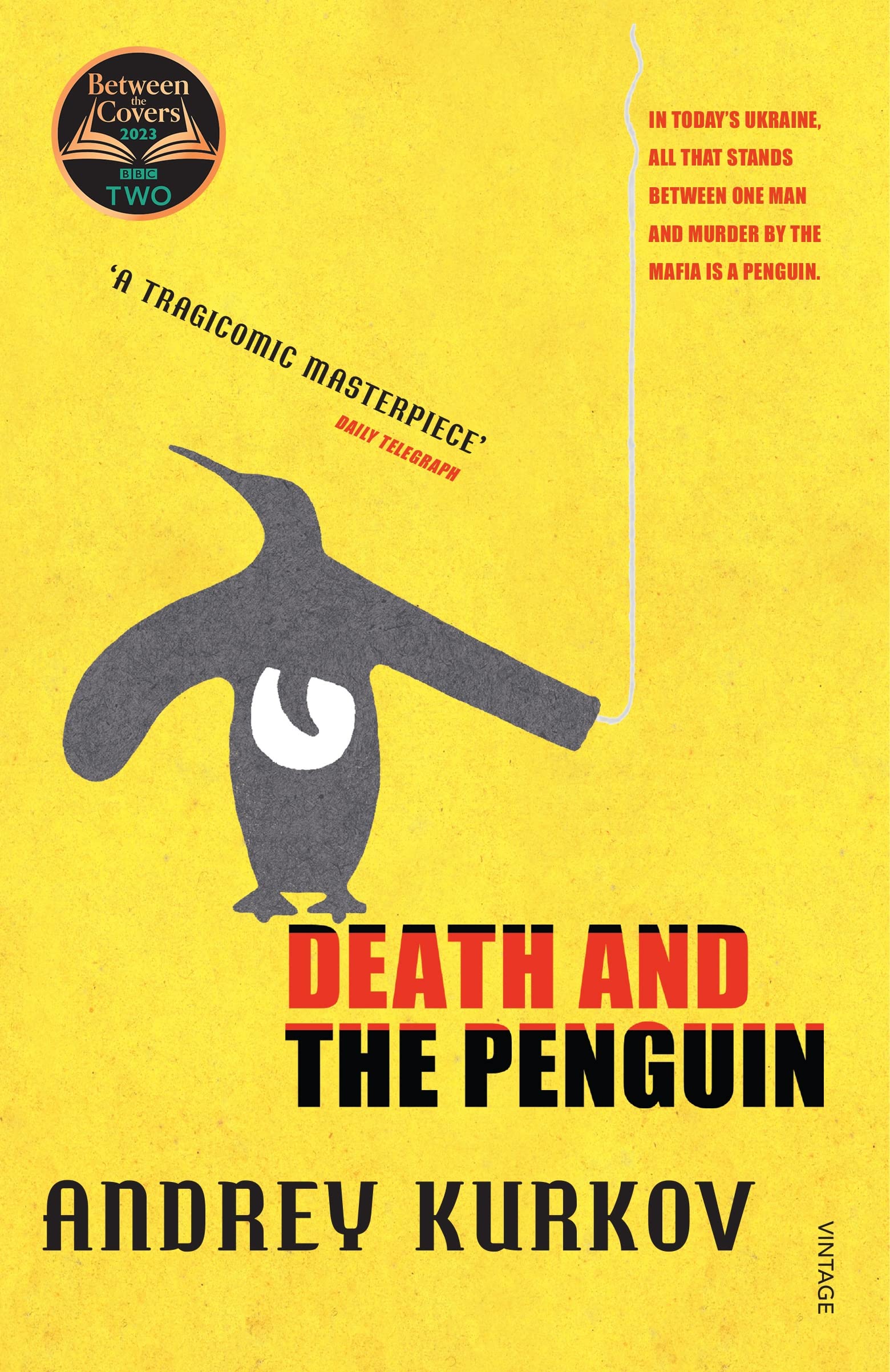
Death & The Penguin by Andrey Kurkov

Death & The Penguin tells the story of a failed writer Viktor Alekseyevich Zolotaryov who lives a lonely life in Kviv, scraping by on selling short, very short, stories. He lives with Misha, a King penguin which he rescued from the local zoo because it could no longer afford to keep all its animals. Viktor is a lonely, melancholic character and Misha is no substitute for human friendship. Misha “brought his own kind of loneliness, with the result of two complementary lonelinesses creating an impression of interdependence rather than amity. 

The setting is Ukraine in the late years of the 20th century. Ukraine is throwing off the constraints of membership of USSR and trying to embrace the freedoms of The West but has become a corrupt and lawless society with most of wealth in the hands of a few. The bleak setting of the country is well-captured, with the novel offering a stark portrayal of life in a post-Soviet society.

Kurkov says that he chose a penguin for Victor's companion because they normally live in colonies, so to live in isolation is completely alien to them. In the same way the people of Ukraine after living a collective life organised by the state are suddenly cut adrift and have learn to live more isolated, individual lives.

Misha is a mirror of Viktor. The pengin roams around the flat, occasionally stopping and heaving a sigh, like an old man weary of both life and himself. At a funeral Viktor bends down and talks to Misha: Well Misha, he sighed stooping to the Penguin’s level, that's how we humans bury our dead. Turning at the sound of his master's voice, Misha fixed on him his tiny sad eyes.

Things look up for Viktor when he lands the job of writing obituaries of notable people for a national paper but very quickly we realise that all is not as it seems – Victor has to be anonymous. “In your own interest”, the chief editor says, and extra details for the obituaries are to be provided by the paper’s crime department. Nearly all the obituraies concern people with a nefarious past. When his boss sends him to Kharkov to meet a correspondent the man is murdered, and the dangers of Viktor’s new job become clear.

As the main plotline of the story develops everything becomes more sinister and threatening, but who is behind the threats is a mystery. Viktor is in the dark and so are we. He is told he has to disappear for a short time for his own safety and later even his boss has to flee. Viktor is shocked to be told he is indirectly responsible for the deaths he writes about, but how? When he confronts the editor with this news, he is told he is safe as long as he knows nothing -  “The full story is what you get told only if and when your work, and with it your existence, are no longer required.”

We get the impression of two sides at war with each other with Viktor, an unwitting pawn, caught in the middle. But who are the goodies and who are the baddies? All is not fully revealed until the end when Viktor reads his own obituary and knows the truth of his boss’s warning. 

The gloomy nature of the story, in which the sun rarely shines, is lightened by other characters.

Sergey the local militiaman becomes a friend and provides Viktor with an escape to a Dacha for New Year. But even here the safety and tranquillity are shattered by an explosion that blows a burglar to pieces and by the unexpected and shocking present of a gun that Viktor receives.

When one criminal character has to flee, he leaves his 4-year-old daughter Sonya in Viktor’s care, and together with Nina who Viktor employs as a nanny, she brings the normality of family life to his home. But poor Viktor struggles to shake off his habitual pessimism and inability to take control. 

“Friendship, something he has never had. Any more than a three-piece suit or real passion. Life had been pale, sickly, and joyless. Even Misha was down in the dumps, as if he too, knew only a pallid life devoid of colours, emotions delights and joyous splashings of the soul. 

Pidpaly, a penguin expert also provides some light relief yet he tells Viktor: You missed out on the time of abundance, you have, said the old man regretfully. Every century there is five years of abundance after which everything goes to pot. You won't see the next five I'm afraid, I certainly won't, but I did at least come in for one lot.

Viktor knows that somehow he is involved in a criminal operation, but he prefers to shrug his shoulders, gaze out of the window, drink vodka and carry on his normal life.

…he had made no effort to grasp what was taking place around him. Until recently, with the arrival of Sonia. And even now, life around him was still dangerously unfathomable, as if he had missed the actual moment when the nature of events might have been fathomed. 

And again:

Although he could not help thinking about it, he found it easier to do so every day, having recognised the complete impossibility of ever changing his life. Harnessed as he was, it was a question of hauling his load until he dropped. So he hauled.

But despite his pretence Viktor is trapped and this aspect of the novel makes for a melancholy read. Even at the end, although Viktor escapes to the Antarctic, we are left wondering what happens to him, to Sonya and Nina and above all to Misha. 

The novel is surreal, often bleak but full of black humour. A drunk fisherman sees Victor, Sergey and a penguin.

Eyes fixed on the Penguin, the fisherman shook his head. “Look”, he said at last, “is that a Penguin you've got there or am I seeing things?” “You're seeing things”, Sergey assured him firmly. “Christ”, he whispered aghast. 

Viktor asks about one of the victims: How did he die? Like they all do, tragically.

One of the strengths of the novel is its ability to combine humour with darker themes. The relationship between Viktor and Misha is often amusing, and the absurdity of Viktor's job as an obituary writer adds a touch of black comedy to the story. However, the novel is also full of poignant moments that explore the loneliness and despair that Viktor feels as he tries to navigate his difficult and dangerous life.

Death and The Penguin is a blend of humour, suspense, and social commentary. Kurkov's writing style is sharp and witty, with a dark undertone that keeps the reader on edge throughout the novel. The portrayal of Kiev's post-Soviet society is bleak and realistic, highlighting the corruption, poverty, and crime that were prevalent during this time. It is a satisfying and thought-provoking read.

Some Quotes

The poor and sinless did not exist, or else died unnoticed and with no obituary. The idea seemed persuasive. Those who merited obituaries had usually achieved things, thought for their ideals, and when locked in battle, it wasn't easy to remain entirely honest and upright. Today's battles were all for material gain, anyway. The crazy idea list was extinct survived by the crazy pragmatist…

“Drink up!" urged the Chief. "There's no escaping fate. Drink while the champagne lasts!” 

Life seemed easy and carefree, despite painful moments and less frequent scruples over his own part in an ugly business. But what, in an ugly world, was ugly? No more than a tiny part of an unknown evil existing generally, but not personally touching him and his little world. And not be fully aware of his part in that ugly something was clearly a guarantee of the indestructibility of his world, and of its tranquillity.

Something was wrong with his life, he thought, walking with downcast eyes. Or life itself had changed, and was as 

Life was a road, and if departed from at a tangent, the longer for it. And a long road was a long life - a case where to travel was better than to arrive, the point of arrival being, after all, always the same: death.

He looked into that future and saw so clearly as if for the first time in his life, everything that obstructed the peaceful path for him. It was, oddly enough all connected indirectly with his beloved Misha. Misha had drawn him into a mournful circle of people with an enhanced degree of mortality and now Misha alone could free him from them. 


Ukraine Context

During the recession, between 1991 and 1999, Ukraine lost 60% of its GDP and suffered from hyperinflation that peaked at 10,000% in 1993.The situation only stabilized well after the new currency, the hryvnia, fell sharply in late 1998 partially as a fallout from the Russian debt default earlier that year. The legacy of the economic policies of the nineties was the mass privatization of state property that created a class of extremely powerful and rich individuals known as the oligarchs.

From the political perspective, one of the defining features of the politics of Ukraine is that for most of the time, it has been divided along two issues: the relation between Ukraine, the West and Russia, and the classical left-right divide.[155] The first two presidents, Kravchuk and Leonid Kuchma, tended to balance the competing visions of Ukraine,[156] though Yushchenko and Yanukovych were generally pro-Western and pro-Russian, respectively. There were two major protests against Yanukovych: the Orange Revolution in 2004, when tens of thousands of people went in protest of election rigging in his favour (Yushchenko was eventually elected president), and another one in the winter of 2013/2014, when more gathered on the Euromaidan to oppose Yanukovych's refusal to sign the European Union–Ukraine Association Agreement. By the end of the 2014 protests, he fled from Ukraine and was removed by the parliament in what is termed the Revolution of Dignity, but Russia refused to recognize the interim pro-Western government, calling it a junta and denouncing the events as a coup d'état sponsored by the United States.[157][158][159]


Wikipedia entry for Andrey Kurkov: 

Kurkov has written 19 Novels: His books are full of black humour, post-Soviet reality and elements of surrealism.

https://en.wikipedia.org/wiki/Andrey_Kurkov 


Thursday, 9 February 2023

Act Of Oblivion by Robert Harris


On the 29th of January 1649, a document was signed by 59 men. Against each signature was a personal seal, stamped in red wax. The third signature read, “O Cromwell”. The document was the death warrant of King Charles I, beheaded in Whitehall the following day. When the axe fell a loud groan rose from the crowd, but perhaps not from 15-year-old Samuel Pepys who was present and later told his school friends, if he had to preach a sermon on the king, his text would be “The memory of the wicked shall rot”. The triumph of Cromwell and the Puritan faction lasted just 11 years. Following Cromwell’s death in 1658, The Commonwealth was finished. Two years later Charles II landed at Dover, and the monarchy was restored. Now it was time for revenge. Parliament passed the Act of Indemnity and Oblivion and the pursuit of the regicides who had signed the death warrant, and who were not already dead or in The Tower was set in motion.

In Act of Oblivion, Robert Harris recreates the story of this pursuit and in particular, the hunt for Edward Whalley and his son-in law William Goffe, who escaped across the Atlantic to the Puritan settlements in New England. In his introduction Harris states, “The events, dates and locations are accurate and almost every character is real”. However, he does invent the character of Richard Nayler, the chief man-hunter who is given a compelling motive for pursuing the regicides to the ends of the earth. Nayler is arrested on Christmas Day by two Colonels from Cromwell’s army. His crime? - celebrating the Feast of the Nativity and using the Book of Common Prayer when such celebrations are forbidden. On the evening of his arrest his pregnant wife Sarah, goes into premature labour and dies giving birth to a stillborn son. Nayler’s mind is now implacably set on hunting down the two colonels who arrested him, none other than Edward Walley and William Goffe now safe in America, so they think. 

We first meet Nayler when he is ordered by the Privy Council to accompany Isabelle Hacker to her home, Stathern Hall in Leicestershire, to fetch the warrant with its list of 59 names, that authorised the execution of the King, Her husband, Colonel Hacker is named on the warrant, one of the three officers ordered to carry out the execution and who is now under arrest. Nayler reads the warrant; “Whereas Charles Stuart King of England is and stands convicted and condemned of High Treason ……..  to be put to death by the severing of his head from his body”,  and so the reader is introduced to one of the most famous documents in English history.


Meanwhile, over in New England, Walley & Goffe begin their quest for survival. They are among fellow believers but not all are willing to hide and feed them. The ultimate authority for the colonies lies with Parliament and the new King. Puritan governors could turn a blind eye to the regicides in their midst but not for long, sooner or later news would reach England and the hunt would begin. So Walley and Goffe are forced from one hiding place to another, with the threat of betrayal and capture ever-present.

Robert Harris skilfully merges fact and fiction in this excellent novel – “a chewy, morally murky slice of history” (The Times). The reader begins to understand the Puritan mindset, the devotion to the bible and prayer; the over-arching authority of preachers and the church; the belief that they are the saints, the chosen ones, and that all the events of their lives and the wider world are in the hands of God – every victory a blessing and every defeat a punishment. He also uses the device of Edward Walley writing his memoirs to inform the reader of the main events of the Civil War. Occasionally the action switches to Europe, with stories of betrayal and murder as the long arm of Parliament seeks revenge on those regicides who had escaped across the channel.

One of my daughters asked me how she could get into history, so I suggested reading historical novels and pointed her in the direction of “An Officer and a Spy” a re-telling of the Dreyfus Affair in 1890’s France, also by Robert Harris. She read it and enjoyed it, and now knows something of the pernicious influence of antisemitism. So, if you want to get lost in a book that reads like a thriller – Hunt, Chase, Hide & Kill are the 4 sections – and at the same time learn more about the struggle between King & Parliament, the New England colonies, and the hunger for religious certainty, you can do no better than read Act of Oblivion.

Saturday, 14 January 2023

Our Souls at Night by Kent Haruf


​Kent Haruf was a teacher and this, his last book is built to some extent on his own story.

In the first chapter an elderly widow, Addie Moore calls on her neighbour, Louis Waters, an elderly widower, with a very unusual request. “I wonder if you would consider coming to my house sometimes to sleep with me.” She makes it clear that this is about her loneliness which is worst at night. Perhaps two lonely old people can find companionship – not sex – together. Louis is reluctant but agrees.

As we read we begin to get the back stories of their lives. Neither had perfect marriages. Addie’s was marred by the tragic death of her 11 year old daughter and Louis’s by his brief affair with a fellow teacher. When Addie’s grandson Jamie, comes to live with her while her son Gene tries to repair his rocky relationship with his wife, Louis & Addie find themselves acting like surrogate parents. This adds a different and youthful dynamic to their new relationship. However, at the end of this brief story, that seems to offer so much hope and fulfilment for two lives in decline, Kent Haruf presents Addie with a painful choice between family and friendship. The reader is left wondering if she made the right decision.

This novella is a sensitive exploration of family life; the damage parents can do to children, the loneliness of old age and the problems of second relationships. All set in a small town where no one’s business is private and where conforming to the social norm is expected. But Addie no longer cares what the neighbours think as she seeks to break free from the constraints of family and society in her new relationship with Louis.

“I made up my mind I’m not going to pay attention to what people think. I’ve done that too long—all my life. I’m not going to live that way anymore.”

​Instead of looking ahead to years of slow decline she wants to slow down the end-of-life clock and create something new. The various themes of the story are explored with warmth and humanity in a minimalist style, short sentences and short chapters in a short book.

The novel is praised by the likes of Peter Carey – “If you have never entered his beautiful singing sentences, I envy you your first time”, and the New York Times – “So delicate and lovely that it has the power to exalt the reader”, but some members of the book group found it disappointing:

Sad & melancholy. Not uplifting with a disappointing ending

Very bitty and unsatisfying. Some key relationships and characters needed to be explored in greater depth. But I liked this quote:

“Who does ever get what they want? It doesn’t seem to happen to many of us if any at all. It’s always two people bumping against each other blindly, acting out old ideas and dreams and mistaken understandings.”

On balance, I hated it!

On the other hand:

Very insightful book

I like the lack of speech marks and the comforting details. It’s an unusual book. Addie and Louis looked back on their lives with sadness and regret but as Louis said, “You can't fix things, can you, Louis said. We always want to. But we can't.”

I enjoyed the beginning and the American scene which I knew from touring that part of the USA. Did not enjoy the ending.

A strong evocation of happiness in old age.


Wednesday, 16 November 2022

The Knowledge of Angels by Jill Paton Walsh


At the beginning of this intriguing novel, Jill Paton Walsh writes:

“The position of a reader in a book is very like that occupied by angels in the world, when angels had any credibility. Yours is like theirs, a hovering, gravely attentive presence, observing everything and from whom nothing is concealed. Like them you are in a fabled world invisible.”

Imagine an island called Grandinsula in the Mediterranean sometime in the 15th century. The island is a theocracy where the uncompromising rule of the Catholic Church holds sway. A humble Cardinal Prince, Severo, watches over the citizens with a wise and benevolent eye. Jews and Saracens are tolerated in their enclaves and are allowed to practise their religion but must conform to strict rules. Into this peaceful, ordered, unchanging society come two strangers. They could not be more different. Their coming sends shock waves through the governing hierarchy and threatens the very foundations of the country.

Villagers collecting snow and ice from a high mountain capture a strange, savage creature. They are shocked to discover under the dirt and long matted hair a child, a girl who was raised by wolves. 

On a seashore two fishermen spot a strange object out at sea and launch their boat. The object is a young man swimming slowly towards the island and very near the end of his strength. 

A central question forms the core of the book: Is a child born with the knowledge of God embedded in its soul just as DNA is embedded in its cells, or is knowledge of God acquired like all other knowledge, from scholars and culture? The answer to the question could condemn the swimmer to death or save him. 

The swimmer is Palinor, a man of high rank from a country called Aclar. Unlike the Grandinsula, Aclar is a liberal society where everyman it's free to think as he wishes and belief in God is a private matter. Palinor is an atheist, for him there is no God. Having arrived in a country ruled by the church and at the time of the inquisition, he is in grave danger. The authorities on the island are willing to accept Jews and Saracens (Muslims) because given time their false ideas may be converted to true belief. Unbelieving gentiles who are simply ignorant are also accepted, as their ignorance can be dispelled by good teaching, but atheists who absolutely deny the existence of God are children of Satan. They must be burned. 

But suppose children are not born with the knowledge of God. Then Palinor did not have that knowledge buried within him at birth; Satan has not entered his soul and he can return home.

The wolf child provides a unique opportunity to answer this crucial question. Does she possess the knowledge of God within her? If she can be civilised and taught to speak without there being any mention of God, and if despite this, she has a sense of the divine then that would prove knowledge of God was innate. 

Severo consults with his friend Beneditx a renowned theologian and sets him the task of proving the existence of God to Palinor. If Palinor can be convinced, then he will be safe. If he cannot then only the wolf child’s ignorance of God can save him.

This is a novel of ideas, about belief and unbelief, about certainty and doubt. But it is not dull and dry, far from it. Jill Paton Walsh writes a good story that carries you along yet also makes you pause and think. She draws the reader down from the lofty angel-view of a dispassionate observer on to the page and into the lives of her characters. You are invested in the life of Josifa, the young novitiate in a convent who is given charge of the wolf-girl, struggling with her day after day to shed the wolf and bring out the child. You share the intellectual dilemmas of Beneditx as he argues the existence of God with Palinor, only to find the firm ground of his certainties giving way beneath him. You grieve for Severo, caught between his high regard for Palinor and the unyielding rule of the inquisition.

Jill Paton Walsh says this is the book she was born to write. On a trip to the island of Mallorca at the time when the whole Islamic world was being encouraged to murder Salman Rushdie the story came to her and she wrote it very quickly.

If your mind enjoys wrestling with the age-old questions that have perplexed the human race for centuries, this is a book to make you wrestle further. Perhaps a book to make you think new thoughts.


Wednesday, 16 March 2022

Oscar Wilde and the Candlelight Murders


It is interesting how one book leads to another. Recently by different routes I found myself immersed in Victorian England and in particular the world of Victorian theatre. Just before Christmas the BBC showed “The Invisible Woman”, a film depicting the relationship between a middle-aged Charles Dickens and a young actress Ellen (Nelly) Ternan. It was based on a biography of the same name by Claire Tomalin and having read her marvelous biography of Dickens I just had to read her life of Nelly Ternan. It did not disappoint.

Tomalin’s portrayal of 19th Century theatre life reminded me of ShadowPlay by Joseph O’Connor, a novel centred around the Lyceum Theatre in 1880’s London, when audiences flocked in to see Henry Irving and Ellen Terry play Hamlet and Ophelia, and when the theatre manager Bram Stoker was struggling to write a best-selling novel (review HVN Sept 2020). So, leading on from the life of Nelly Ternan I found Ellen Terry’s gossipy autobiography online and was once more immersed in the life and society of late Victorian England which of course included a certain Oscar Wilde, dandy, poet, playwright, and wit. Wilde gets a walk on part in Shadowplay, and Ellen Terry records that Wilde and Whistler where without doubt the most remarkable men she knew.

Which brings me to “Oscar Wilde and The Candlelight Murders”, the first in a series of six novels by Giles Brandreth. Brandreth says, “What makes Wilde particularly attractive as a character to write about is that he was such a fascinating and engaging human being.  What makes him particularly useful – and credible – as a Victorian detective is that he had extraordinary access to all types and conditions of men and women, from the most celebrated to society’s outcasts, from the Prince of Wales to common prostitutes.” So, in The Candlelight Murders Oscar Wilde has turned detective, taking on the mantle of Sherlock Holmes who was just making his appearance in the stories of Wilde’s friend Arthur Conan Doyle. Giles Brandreth has great fun playing with the Sherlock Homes theme and gives Wilde his own Dr Watson in the shape of his friend and first biographer Robert Sherard. Here’s part of the intro to the novel:

“My name is Robert Sherard, and I was a friend of Oscar Wilde …. I kept a journal of our times together. I promised Oscar that for fifty years I would keep his secret. I have kept my word. And now the time has come when I can break my silence. At last, I can reveal all that I know of Oscar Wilde and the Candlelight Murders. I must do it, for I have the record. I was there. I am the witness.”

On the first page Wilde hurries to an appointment. He enters a room expecting to meet someone but instead sees the naked body of young Billy Wood, lying on the floor, illuminated by six candles and with his throat cut. Yet when Wilde returns to the scene of the crime with Conan Doyle, the room is completely empty and completely clean. Who murdered Billy Wood and why, are the central mysteries of the novel? The police are strangely reluctant to pursue the case; a vicious stepfather is an obvious suspect; who are the men who meet at 23 Cowley St? Brandreth sets the puzzles early on and deftly merges the real, yet fictitious Wilde with the wholly fictitious Holmes in this exchange:

‘No, no, believe me,’ he (Wilde) went on. ‘Arthur wants to get away at once. His train departs within the hour. He has his ticket and scant means to buy another. He is strapped for cash, Robert. Like you, money is a perpetual worry to him. Unlike you, he pays his bills on time. Besides, it is his wife’s birthday, and he is eager to hasten back to her, bearing gifts.’ Oscar paused to sip his coffee. Doyle was gazing at him, wide-eyed with admiration. ‘Mr. Wilde, you are amazing,’ he said. ‘You are correct in every particular.’ ‘Come, Arthur, no more “Mr. Wilde”, please. I am your friend. And I have studied your Study in Scarlet. This was scarcely a three-pipe problem.’

The Candlelight Murders is an enjoyable romp through the seedy Victorian underworld of rent boys and secret societies, heavily spiced with Wildean wit and epigrams. Like all detective novels red herrings abound and Wilde of course has worked out the main suspect while the reader is still floundering among the fish. This is a highly readable and very enjoyable story but despite the evocation of Wilde’s wit and the Sherlock Holmes persona not in the top tier of detective fiction.

Giles Brandreth has been obsessed with Wilde since he was young and he says: “One hundred and seven years after his death, I am still having fun in his company and if you read Oscar Wilde and the Candlelight Murders, I hope you will, too.   As Oscar once said, ‘There is nothing quite like an unexpected death for lifting the spirits.’”


Interview with Giles Brandreth

Writer, broadcaster, former MP and government whip, Gyles Brandreth , makes his first foray into
detective fiction with OSCAR WILDE AND THE CANDLELIGHT MURDERS , published by John Murray on 10 May 2007.  The novel is the first in a series of Victorian murder mysteries by Brandreth , each of them featuring Oscar Wilde as the detective.

How did it come about?  Gyles Brandreth explains:

It’s a long story, so I will try to keep it short.

Since I was a boy, I have been an avid admirer of both the works of Oscar Wilde and the adventures of Sherlock Holmes.  (At school, my best friend was the actor, Simon Cadell.  He starred in my school production of A Study in Sherlock.  Jeremy Brett was brilliant as Holmes, I grant you.  But for me, Simon, aged twelve, was definitive!)

Anyway . . . about ten years ago, in the late 1990s, by chance, I picked up a copy of Memories and Adventures, the autobiography of Arthur Conan Doyle, published by John Murray in 1924, and discovered, on page 94, that Arthur Conan Doyle and Oscar Wilde were friends.  I was amazed.  It would be hard to imagine an odder couple.

They met in 1889, at the newly-built Langham Hotel in Portland Place.  They were brought together by an American publisher, J M Stoddart, who happened to be in London commissioning material for Lippincott’s Magazine.  Evidently, Oscar, then 35, was on song that night and Conan Doyle, 30, was impressed – and charmed.  The upshot of the evening was that Mr Stoddart got to publish both Arthur Conan Doyle’s second Sherlock Holmes story, The Sign of Four, and Oscar Wilde’s novel, The Picture of Dorian Gray, and I was inspired to write the first of ‘The Oscar Wilde Murder Mysteries’.

My story begins on the afternoon of the day of Wilde and Conan Doyle’s first encounter.  Oscar calls on a house in Cowley Street, Westminster, expecting to meet up with a friend – a female friend, as it happens, a young actress . . .  Instead, in a darkened upstairs room, fragrant with incense, he discovers the naked body of a boy of sixteen, his throat cut from ear to ear.

Wilde, established poet and wit, ‘the champion of aestheticism’, (and happily married to Constance and living in Tite Street, Chelsea, with their two sons), turns to Conan Doyle, doctor and writer of detective fiction, ‘the coming man’ (still practising as a general practitioner in Southsea), for help - but Conan Doyle quickly discovers that when it comes to the art and craft of amateur sleuthing Oscar Wilde has very little to learn from Sherlock Holmes.   Wilde is overweight and apparently indolent (more Mycroft than Sherlock Holmes), but his mind is amazing: his intellect is as sharp as his wit.  Oscar Wilde, in his own way, is as brilliant as Sherlock Holmes - and just as Holmes had his weakness for cocaine, Wilde has his weaknesses, too.

Famously, Wilde was a brilliant conversationalist.  He was, also, by every account, a careful listener and an acute observer.  And he had a poet’s eye.  He observed: he listened: he reflected: and then – with his extraordinary gifts of imagination and intellect – he saw the truth . . .  What makes Wilde particularly attractive as a character to write about is that he was such a fascinating and engaging human being.  What makes him particularly useful – and credible – as a Victorian detective is that he ad extraordinary access to all types and conditions of men and women, from the most celebrated to society’s outcasts, from the Prince of Wales to common prostitutes.

Dr Arthur Conan Doyle is central to Oscar Wilde and the Candlelight Murders – as he will be to the sequels in the series – but, in my book, he is not Wilde’s Dr Watson.  That role falls to one Robert Sherard, a journalist, poet, ladies’ man, and Wilde’s first, most frequent and most loyal biographer.  Sherard first met Wilde in 1882 in Paris and, throughout their friendship, which lasted until Wilde’s death in 1900, kept a detailed journal of their time together.

Oscar Wilde – dandy, detective, playwright, and, eventually, convicted corrupter of young men - died at about 1.45 pm on 30 November 1900 in a small, dingy first floor room at L’Hotel d’Alsace, 13 rue des Beaux-Arts, Paris.  He was just 46.  Exactly one hundred years later, in the same hotel, in the same bedroom (now expensively refurbished), a band of devotees - twenty or so of us: English, Irish, French, American - gathered to honour the man whose greatest play, according to Frank Harris, was his own life: ‘a five act tragedy with Greek implications, and he was its most ardent spectator.’

It was at 1.45 pm on that Thursday afternoon in Paris that I decided I wanted to write ‘The Oscar Wilde Murder Mysteries’.   It was a memorable occasion.  An Anglo-Catholic clergyman - a Canon of Christ Church, Oxford: he was tall and blond, called Beau and came from Cincinatti: Oscar would have approved - lit a candle and led us in prayer.  There was a minute’s silence and some tears and, later, as we toasted the shade of the great man in champagne (absinthe is now outlawed in France), much laughter.  We gazed in wonder at the huge turquoise peacocks decorating the wall above the bed and recalled Oscar’s last recorded quip: ‘My wallpaper and I are fighting a duel to the death.  One or other of us has to go.’

Oscar Wilde has been a figure of fascination to me for as long as I can remember.   I was born in 1948 in Germany, where, in the aftermath of the Second World War, my father was serving as a legal officer with the Allied Control Commission.  He counted among his colleagues, H Montgomery Hyde, who, in 1948, published the first full account of the trials of Oscar Wilde.  It was the first non-fiction book I ever read!  (In 1974, at the Oxford Theatre Festival, I produced the first stage version of The Trials of Oscar Wilde, with Tom Baker as Wilde, and, in 2000, I edited the transcripts of the trials for an audio production starring Martin Jarvis.)  In 1961, when I was thirteen, I was given the Complete Works of Oscar Wilde and read them from cover to cover - yes, all 1,118 pages.   I can’t have understood much, but I relished the language and learnt by heart his Phrases and Philosophies for the Use of the Young – eg: ‘Wickedness is a myth invented by good people to account for the curious attractiveness of others.’

As a child I felt close to Oscar for another reason.  I was a pupil at Bedales School, where, in 1895, Cyril, the older of the Wildes’ two sons, had been at school.  The founder of Bedales, John Badley, was a friend of Wilde’s, and was still alive and living in the school grounds when I was a boy.  Mr Badley told me (in 1965, at around the time of his hundredth birthday) that he believed much of Oscar’s wit was ‘studied’.  He recalled staying at a house party in Cambridge with Oscar and travelling back with him to London by train.  Assorted fellow guests came to the station to see them on their way.  At the moment the train was due to pull out, Wilde delivered a valedictory quip, then the guard blew the whistle and waved his green flag, the admirers on the platform cheered, Wilde sank back into his seat and the train moved off.  Unfortunately, it only moved a yard or two before juddering to a halt.  The group on the platform gathered again outside the compartment occupied by Wilde and Badley.  Oscar hid behind his newspaper and hissed at his companion, ‘They’ve had my parting shot.  I only prepared one.’

When I told this story to the actor, Sir Donald Sinden, he volunteered that, in the 1940s, when he knew him, Lord Alfred Douglas had told him, too, that much of Oscar Wilde’s spontaneous wit was carefully worked out in advance.  Never mind how he did it - he did it.  Bernard Shaw said, ‘He was incomparably the greatest talker of his time - perhaps of all time.’ 

John Badley told me, ‘Oscar Wilde could listen as well as talk.  He put himself out to be entertaining.   You know, he said, “Murder is always a mistake.  One should never do anything that one cannot talk about after dinner.”   He was a delightful person, charming and brilliant, with the most perfect manners of any man I ever met.  Because of his imprisonment and disgrace he is seen nowadays as a tragic figure.  That should not be his lasting memorial.  I knew him quite well.  He was such fun.’

One hundred and seven years after his death, I am still having fun in his company and if you read Oscar Wilde and the Candlelight Murders I hope you will, too.   As Oscar once said, ‘There is nothing quite like an unexpected death for lifting the spirits.’

http://www.shotsmag.co.uk/feature_view.aspx?FEATURE_ID=143


Tuesday, 3 November 2020

Go Set A Watchman by Harper Lee


In the Spring of 1957, an American publisher received the first novel from 31-year-old Harper Lee. “The spark of the true writer flashed in every line," her editor said, but nevertheless declared it not fit for publication – “more a series of anecdotes than a fully conceived novel". Lee and her editor completely reworked the manuscript and three years later, one of the great classics of the 20th Century, “To Kill A Mockingbird”, was published.

For me, and for many others, it is in the top rank of favourite novels, and Atticus Finch is one of the great literary heroes. So, when the reclusive Harper Lee published “Go Set A Watchman” in 2015, a supposed sequel, it created a stir. Atticus Finch of all people had turned racist; the saint had turned sinner and I determined never to read it. But horror of horrors, last year it was chosen for our book group and I had to bite the bullet. What a revelation – I loved it and read it twice!

GSAW is not a sequel but the original manuscript from 1957. It was written when the US Supreme Court had ruled that education in every state must be de-segregated and the National Association for the Advancement of Coloured People was growing in power and influence. The southern states felt under threat and the deep tensions that emerged form the background to the novel.

We are 20 years on from TKAM and “Colour-blind” Jean Louise Finch returns to her hometown to find her New York values are not only at odds with Maycomb but tragically at odds with her much-revered Father and also her would-be husband. The flashbacks to childhood where black and white lived alongside each other in a separated harmony and where six-year-old Scout had no understanding of the currents building in the black community contrast sharply with the present where the currents are running strong, and the demand for equal rights is not only tearing the community apart but also tearing Jean Louise from those she holds dear.

At a church service she hears this text from Isaiah:

“For thus hath the Lord said unto me, Go, set a watchman, let him declare what he seeth.” (Is 21:6)

“Fallen, fallen is Babylon; And all the images of her gods are shattered on the ground.”

Isaiah saw the coming destruction of Babylon and liberation of the Jews from captivity, and Jean Louise sees the coming liberation of African-Americans from subservience to full citizenship, but her contemporaries are oblivious. In a social gathering, young women she grew up with talk openly of doing away with the Negro race. She reflects on how the great words of the Gettysburg Address have become a grotesque parody:

“Conceived in mistrust and dedicated to the proposition that all men are created evil.”

“I hope the world will little note nor long remember what you are saying here.”

She thinks, “I should like to take your head apart, put a fact in it, and watch it go its way through the runnels of your brain until it comes out of your mouth. We were both born here, we went to the same schools, we were taught the same things. I wonder what you saw and heard.”

At a key point in the novel she confronts Atticus and her language is visceral:

“Atticus, I’m throwing it at you and I’m gonna grind it in: you better go warn your younger friends that if they want to preserve Our Way of Life, it begins at home. It doesn’t begin with the schools or the churches or any place but home. Tell’ em that, and use your blind, immoral, misguided, nigger - lovin’ daughter as your example. Go in front of me with a bell and say, ‘Unclean!”

She wants no more to do with Maycomb and no more to do with Atticus. But her uncle halts her flight.  He says, she has revered her father too much and turned him into a God - “And all the images of her gods are shattered on the ground.”

A famous passage from TKAM is:

“You never really understand a person until you consider things from his point of view... Until you climb inside of his skin and walk around in it.”

Her uncle makes Jean Louise realise that her conscience, her Watchman as he calls it, is not the same as her father’s and she needs a new relationship with him, adult to adult.

GSAW is an uncompromising call for justice seen through the eyes of an adult, but it was transformed into TKAM narrated by a child. Was this because Harper Lee could not reconcile the Old Testament voice of the prophet calling for justice and righteousness with the New Testament message of mercy and forgiveness? TKAM removed the conflict between Atticus and Jean Louise, the cry of the prophet was silenced, and Atticus was able to stand Christ-like, for mercy and forgiveness.

If you have never read either, then do read TKAM. But I found GSAW far more powerful in the themes it explores; more realistic and less idealistic than TKAM.

Sunday, 9 February 2020

Shadow Play by Joseph O'Connor

Shadowplay is a wonderful, lyrical novel set around the life of Bram Stoker and his time as manager of London's Lyceum Theatre in late Victorian London. The two stars of the Lyceum were its owner Henry Irving, a vain, demanding martinet and Ellen Terry, witty, seductive and very much in control of her own destiny.

The story is a marvellous imagining of this three-sided relationship and switches between first and third person, letters and dialogue to weave a compelling narrative. Anyone who has  enjoyed O'Connor's Star of The Sea will find more riches to feast on here. You lose yourself in the London where Oscar Wilde is on trial by day and Jack the Ripper walks the East End by night.

Ellen Terry, on Hery Irving:

"Make no mistake he was a peerless actor. The greatest I'll ever see. Majestic, powerful, like an animal not a man. You couldn't look away not even for a second. It was as though your neck was in a vice and your eyes on the stage....

Trouble is he adored the applause and that gets in the way. There's a certain sort of actor, a clap-hound I call them, who do anything for the applause, set himself on fire if he needs to. Harry was King of the clap-hounds. He did it too often. It was like watching the world's greatest concert pianist juggling coconuts in a booth on Southend Pier. Fine, so far as it goes. But there's a Steinway behind you darling. Give us a ruddy tune while you're up there."


But what of Dracula? This one book, famous the world over, is why we know the name Bram Stoker -who knew he was a theatre manager?

Throughout Shadowplay, we see Bram, a struggling author, forever twarted by his day job. He sneaks away to an attic, haunted by the ghost of a dead servant girl, to write stories and a novel but nothing sells; yet slowly a new story is developing in his head. As Shadowplay unfolds, hints of Dracula begin to emerge - a stage painter called Jonathan Harker, a box of earth, the blood and horror of the Ripper, a lunatic assylum where an inmate eats flies, a visit to Whitby. Behind the genesis of Dracula is the shadow world of the theatre, a place of drama, emotion and other worlds, where actors lose their identity and Shylock, Hamlet and Ophelia never die.
 
Article about Bram Stoker by Joseph O'Connor 

Much better review of Shadowplay in The Times


Tuesday, 28 January 2020

Americanah by Chimamanda Ngozi Adichie


Chimamanda Ngozi Adichie is an award-winning Nigerian author who writes about her homeland and how its people are conflicted between their own unique African identities and the onrushing tide of Westernisation.

 Her first novel, Purple Hibiscus was set in a time when Nigeria was ruled by an army dictatorship; her second, Half of a Yellow Sun, covers the civil war at the end of the 1960s when the state of Biafra attempted to form a separate country for the Igbo people. Americanah moves to more recent times when teachers and lecturers are on strike, causing many students to leave Nigeria to seek higher education in the USA or UK. Adichie is a very talented writer and I would strongly recommend all three.

In Americanah we follow the lives of Ifemelu and Obinze from the friendship of their school days through to a growing affection and a deepening relationship in their teens. They have become soulmates but are now forced apart when Ifemelu leaves Nigeria for the USA to continue her stalled education. She expects Obinze to follow her, but he is unable to do so and ends up in the UK. Unable to pay her rent and unable to get a job Ifemelu cuts herself off from all contact with Obinze, not replying to his many letters and emails.

Here are two intelligent, aspirational, young Nigerians seeking an education worthy of their talents but now seen as strangers and aliens, having to fight to achieve status and recognition against immigration barriers and endemic racism. Their ambitions are frustrated at every turn and Obinze is forced back to Nigeria.

Adiche studied in the USA and cleverly throws a strong light on racist issues by means of Ifemelu starting a blog called "Raceteenth". Some blog posts are interspersed with the text of the novel and take the reader out its fictional world into the harsh reality of the real thing.

One particularly moving episode in Americanah is the election of Obama as the first black president of the USA

Blaine was crying holding Araminta who was crying then holding Ifemelu squeezing her too tight and Pee was hugging Michael and Grace was hugging Nathan and Paula hugging Araminta and Ifemelu was hugging Grace, and the living room became an altar of disbelieving joy.
Her phone bleeped with a text from Dike, “I can't believe it. My president is black like me.” She read the text few times her eyes filling with tears.
On television, Barack Obama and Michelle Obama and their two daughters were walking onto a stage. They were carried by the wind, bathed in incandescent light, victorious and smiling. 
“Young and old, rich and poor, Democrat and Republican, black, white Hispanic, Asian, Native American, gay, straight, disabled and not disabled, Americans have sent a message to the world that we have never been just a collection of red States and blue, states. We have been and always will be the United States of America”
Remember those heady days when the world seemed to turn a corner of tolerance and hope? Read this and weep.

Although this novel is rich in many things, the central core is a love story. Can young love survive change and maturity, the separation of distance and time, and the emotional turmoil of other relationships?

Chimamanda Ngozi Adichie has given a TED talk on "The Danger of a Single Story" and this beautifully written novel challenges the reader to open his/her mind to the multitude of stories of other people and other nations so we may better understand our common humanity.

Sunday, 8 July 2018

How to Stop Time by Matt Haigh

Physics tells us that time passes more slowly the faster you go but suppose it goes more slowly for some individuals because they age very slowly. This is the unusual concept behind this novel. 

Tom Hazard was born in Tudor times but despite living over 450 years, is only 40ish in appearance in the present day. This raises lots of problems. How do you marry and have children when they and your wife grow old and die, leaving a still very young you behind? What happens when witch-fearing neighbours notice that you never look a day older? They only thing to do is move, and make a new life somewhere else for a few years, but above all the golden rule is, “don't fall in love”. 

We follow Tom through a series of switchbacks to earlier times, where he does marry and does have a child. His daughter has inherited his condition of slow-aging but he loses track of her when her mother died and has spent the rest of his life searching for her. So far, so OK. But for me the follow through in terms of plot does not hang together well. 

There are a lot of philosophical musings about life and fear of the future, but the punch line is a truism - forget the future and just live the present. If you like The Time-travellers Wife then you should find How to Stop Time an interesting read.

Monday, 2 July 2018

Little Fires Everywhere by Celeste Ng

This story is set in the US in the Clinton era, among the ordered, wealthy lives of Shaker Heights, a planned community on the edge of Cleveland, Ohio. The central family is the Richardson's, Mum & Dad, Trip, Lexie, Moody and Izzy. Like all the other families of Shaker Heights, their lives are lived by rules and routine. Mum is a journalist and Dad a lawyer, and the children are programmed to follow middle class aspirations of good school, prestigious college, high-salaried job, marriage, children etc etc. Disturbing the even tenor of their ways is the youngest daughter Izzy, who doesn't quite fit, will not conform, and with her Dr Martin boots, loud music and slammed doors, is a continual source of irritation to her mother. Then Mia, unmarried mother, photographer and rule-breaker moves into the area with her intelligent daughter Pearl, and Mrs Richardson's carefully ordered world is shaken to its core.


Mia does not take photographs, she makes art, with total absorption and passion. She challenges the values of the onlookers, forcing them to see the world through different eyes, and Celeste Ng uses this as the main metaphor in the book.

Mrs Richardson in contrast, with her fixed, conventional worldview, "had learned that passion, like fire, was a dangerous thing. It so easily went out of control... Rules exist for a reason: if you followed them you would succeed; if you didn't, you might burn the world to the ground".

Behind the order and convention of Shaker Heights, with the crisp lawns and immaculate houses, the lives of the people were not pretty pictures but were complex and messy. Values and ideas that can deal with mess and chaos are the ones that win out over those that rely on rules and order.

The story starts with a fire and then goes back to trace the many threads that led up to it. At the end we come full circle and a final set of photographs that reveal how Mia saw the Richardson family more clearly than they saw themselves.

Monday, 18 June 2018

A Legacy of Spies and Red Notice

A Legacy of Spies by John LeCarré

For fans of "The Spy Who Came in From The Cold", and arch spymaster, George Smiley, this is a return to familiar and much-loved territory. We are again plunged into a world where our intelligence is stretched to the limit by crpytic jargon, non-linear narrative, and jigsaw pieces of truth that scatter as soon as we begin to piece them together. It is modern day and children of victims of "Windfall", a failed covert operation from cold-ward days, intend to sue the British intelligence services for the deaths of their parents. The fall guy is Peter Guillam who is called back from his retirement on a Breton farm and subject to interrogation. All the past files, including those kept by the Stasi, are put before Guillam and Le LeCarré uses this novel as a re-run of "The Spy..." and the hunt for the traitor in British intelligence. It's a very good, page-turning read but, to me does not have a good ending.

Red Notice by Bill Browder

This is the second book about the corruption at the heart of the Russian state that I've read this year. Bill Browder tells the story of how he became involved in making money for investors by buying into new capitalist enterprises, first in Eastern Europe and then in Russia. Just like the first book, "Nothing is True and Everything is Possible" by Peter Pomerantsev, modern Russia is revealed as an alien world to those of us living under democratic systems. Although our society has many ills, we are nowhere near the state controlled gangsterism, corruption of the police and judiciary, or state control of the media and electoral system that prevail in Russia.

The tragic heart of this book is a young Russian lawyer, Sergie Magnitsky, who was beaten to death by eight Russian police officers after exposing the theft of $230 million of taxes by Russian government officials. Eventually this led to the USA passing a Magnitsky Law that enabled the seizing of assets of Russian criminal oligarchs who are using the West to launder the millions made from their nefarious enterprises.

As Lee Child says on the cover of the book, "Reads like a classic thriller..", and I read it it in 5 days.

Saturday, 5 May 2018

The Goldfinch by Donna Tartt

This book has been on my must-read list for a while. It is a highly recommended novel and people comment, “I envy you reading this for the first time”. The heavyweight press seem to give it universal praise. Here’s one quote from the Financial Times review,

“Like a Dutch painting, every scene is described in glittering detail and framed with retrospective melancholy. A modern-day David Copperfield… The Goldfinch is impressive – lavish, gripping, exciting” (Emily Stokes).

The book is a door-stopper in length and spans a period of about 20 years in the life of the narrator, Theo Decker. As a 13-year-old boy he is taken to an art gallery by his mother. A bomb explodes, his mother dies, and Theo finds himself next to a dying man, Welty, who gives him a ring and an address. Nearby is a small painting which Theo takes with him as finds his way through the dust and rubble into the open air. The address turns out to be a shop selling antiques and the home of Hobie, an expert antique restorer and Welty’s partner. The painting is The Goldfinch by a Dutch artist, Fabritus and Theo’s unlawful possession of The Goldfinch is the main thread running through the story.

Theo is first fostered by a rich family, the Barbour’s, but his father, long estranged from his mother, comes to claim him and takes him to live in Las Vegas. Here he meets Boris, originally from the Ukraine, who introduces him to a decedent life of drugs, drink and stealing. After the death of his father, Theo moves back to New York where he lives with Hobie and becomes an expert in selling fake antiques. He hides The Goldfinch away in a storage facility but then is told that it’s been stolen. In the last section of the book Theo goes with Boris to Holland in pursuit of the painting.

Another thread in the story is Theo’s unrequited love for Pippa, a girl of his age who had also been in the explosion with Welty and who recuperated at Hobie’s. To rid himself of his feelings for Pippa Theo tries to concentrate on her flaws:

”yet all these aspects were – to me - so tender and particular they moved me to despair. With a beautiful girl I could have consoled myself that she was out of my league; that I was haunted and stirred even by her plainness suggested – ominously – a love more binding than physical affection, some tar pit of the soul where I might flop around and malinger for years. …..She was the missing kingdom, the unbruised part of myself I had lost with my mother.”

The wonderful, descriptive writing makes this a fine book. Donna Tartt is an expert in conveying images of people, places and the atmosphere in which they live and breathe. So, the quality of the writing is excellent, but there are things I didn’t like. I found the whole scenario by which Theo comes to possess The Goldfinch and then to hang on to it, to be very implausible, which is a problem when the whole story hangs on this. Then, you have to buy into Theo himself, as he is the narrator, but once his life is invaded by his father and Boris, he loses the sensitivity of the relationship he had with his mother and I rapidly lost sympathy for him. We are all victims of circumstance but also victims of our own choices, and to me Theo’s life was a catalogue of bizarre wrong choices.

Another issue is the peripheral nature of some of the “main” characters. Although Theo obsesses about Pippa throughout the 800-odd pages, she just flits in and out of the story and ultimately does not seem that important. Theo’s relationship with Boris is the strongest in the book and it is Boris who is instrumental in tracking down the painting after it has been stolen, but he drops out of the story for 200 pages, before coming back for the crucial denouement. Hobie too, the innocent, good guy and a true father-figure who provides Theo with a home and teaches him the mysteries of antique furniture, in the end is only a bit-part player.

Another problem with the novel is its length. Right at the beginning, after the explosion, it takes 20 pages for Theo to have contact with a dying man and get out into the open air. Numerous pages are devoted to Theo's drug and drink habits which leave him miserable and suicidal. I found myself skimming at the end when Theo is in an Amsterdam hotel room being taken through yet another bout of depression by the author.

There is no doubting Donna Tartt's wonderful writing ability, and The Goldfinich shows this in spades, so great prose, with some memorable characters, but to my mind lacking narrative drive.

Thursday, 15 February 2018

A Gentleman in Moscow by Amor Towles

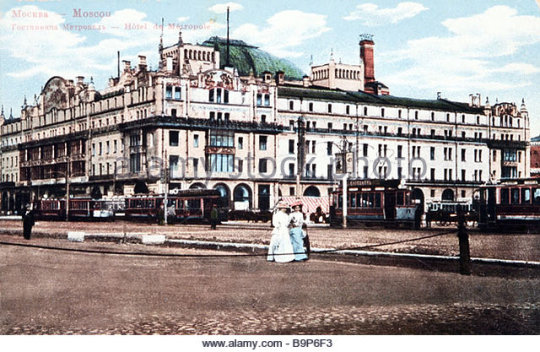
I can’t believe that “Days Without End” by Sebastian Barry has been already knocked off the top spot for this year’s best reads, and having enthused about that book I don’t know how to describe the overwhelming delight I had from reading “A Gentleman in Moscow. It was a feast of a book, like a meal with a succession of mouthwatering dishes, superb wines, wonderful company and briliant conversation. The gentleman in question is Count Alexander Ilych Rostov who is a resident in The Metropol, the most prestigious hotel in Moscow. As a member of the aristocracy in 1922, he no longer has a place in post-revolutionary Russia, but instead of being shot, or given a one way ticket to Siberia, he is made a non-person and sentenced to house arrest back at the Metropol, no longer in his palatial suite however, but up in a tiny attic room. If you know Charlie Mortdecai from the Bonfiglioli books, or have seen "The Grand Budapest Hotel”, you get an idea of the flavour of this book. 
Early on we have these lines:
”After all, what can a first impression tell us about someone we’ve just met for a minute in the lobby of the hotel? For that matter, what can a first impression tell us about anyone? Why, no more than a chord can tell us about Beethoven or a brushstroke about Botticelli. By their very nature, human beings are so capricious, so complex, so delightfully contradictory, that they deserve not only our consideration, but our reconsideration–and our unwavering determination to withhold our opinion until we have engaged with them in every possible setting at every possible hour.”


image

The book progress from 1922 through to 1954 and we meet many engaging characters en route, including, the chef, the concierge and the seamstress, Russian officials, visiting Americans, a beautiful actress, and two precocious young girls who grow to adulthood, and play a key role in the story. One of them, at the age of 9 decides she needs to compile a list of the Prime Numbers and test Galileo’s ideas about falling objects. The other plays the Count at a game they call “Zut”, in which you have to name members of a category e.g the uses of wax or things that come in fours. 
There is poetry, philosophy and humour with the unexpected lurking at the turn of the page, all set down in masterful prose. You are taken on a journey where the journey is more important than the destination, although the final destination seals the perfection of the book.