Saturday, 15 February 2025
Saturday, 1 February 2025
The People Immortal by Vasily Grossman
Vasily Grossman was a Soviet war reporter in WWII, He was born in in 1905, in Berdychiv , Ukraine - also the birthpalce of Joseph Conrad. He studied to be a chemical engineer but decided he really wanted to be a reporter.
In June 1941 Hitler invaded the Soviet Union despite his non-agression pact with Stalin. Stalin's agents had warned him invasion was immanent but he ignored them and the German attack took them completely by suprise, To make matters worse Stalin had purged the army of it's top officers, his army was under-strength and under-led. The Germans on the other hand were better led, better trained and much better equipped. The Russians were forced to retreat. They staged holding operations and counter attacks that only served to slow the advancing Germans. This is the setting for The People Immortal, in which a batallion thrown into the fight finds itself trapped and needing to breakout of the encirclement.
Grossman was a front line war reporter and witnessed this hopeless attempt to halt the invasion. His reports were very popular both with the troops and the civilian population. He was given leave of absence for two weeks in 1942 to write a novel to inspire the people in their struggle for survival and to give them hope of eventual victory. The result was The People Immortal.
At the beginning of the novel a researcher, Sergey Alexandrovich Bogariov, leaves his books and manuscripts to join the army as a high ranking political officer.In thousands of trucks the army streams south and west to repel the invader.
The People Immortal above all brings out the determination of the Soviet people to defend their homeland against the invading forces. The characters' unwavering commitment to their country and their willingness to make the ultimate sacrifice highlight the profound sense of duty and loyalty that pervades the novel.
Despite the brutality of war, the novel also emphasizes the importance of humanity and compassion. The characters' acts of kindness, their support for one another, and their enduring friendships serve as a testament to the enduring strength of the human spirit.
Grossman does not shy away from depicting the horrors and devastation of war. The graphic and unflinching portrayal of the battles, the suffering of the soldiers, and the destruction of towns and villages underscore the immense toll that the conflict takes on both the individuals and the nation.
The Russian people suffered terribly in the Second World War. They lost 27 million people, 16% of the population - the Uk lost 1%. No wonder they call it The Great Patriotic War. We read in our book group The Siege by Helen Dunmore, set in the siege of Leningrad that lasted 600 days before it was relieved. The people of Leningrad were reduced to starvation level, many of them dying of cold and hunger.
I've read. Grossman's Life and Fate and I've also read The Unwomanly Face of War by Svetlana Alexievich, which is a telling testimony to how the lives of ordinary people are tragically affected by war. Terrific courage, humanity and self-sacrifice on one hand and grim, deep hatred on the other.
The humanity of the people and their courage are what come across to me more than anything else in The People Immortal. The soldiers are trying to repel an enemy from taking their land, their home and their memories. The land where parents, grandparents and all their ancestors have toiled to build a heritage. They would rather sacrifice themselves ("hold their manhood cheap") than concede it to the invader?
There's a lovely passage near the end of the book when a messenger breaks through the encirclement to deliver letters:
""How the hell? The road's been cut." "I found ways, Comrade Commissar. I crept four kilometres on my belly. I crossed the river at night, and I shot a German sentry. Look— here's his shoulder strap." "Weren't you scared?" asked Bogariov. "Scared?" the soldier replied, with a little smile. "Why? My soul's not so precious. I'd price it at five kopeks. No more than a balalaika. Why should I be afraid for "Really?"
Grossman can certainly stir the heart. Here's a Land of Hope and Glory moment:
Great is the people whose sons die such stern, simple and sacred deaths on these vast fields of battle. The sky and the stars know about them; the earth has heard their last sighs; the unreaped rye and the roadside trees have witnessed their deeds. They sleep in the earth, with the sky, the sun and the clouds above them. They sleep soundly, they sleep an eternal sleep, as do their fathers and grandfathers, men who worked all their lives as carpenters, navvies, miners, weavers and peasant-farmers of a great land.
It reminded me of this little verse by Alexander Gray
This is my country,The land that begat me.These windy spacesAre surely my own.And those who here toilIn the sweat of their facesAre flesh of my flesh,And bone of my bone.
We few, we happy few, we band of brothers;
For he to-day that sheds his blood with meShall be my brother; be he ne'er so vile,This day shall gentle his condition:And gentlemen in England now a-bedShall think themselves accursed they were not here,And hold their manhoods cheap whiles any speaksThat fought with us upon Saint Crispin's day.
But set this high patriotism against these lines from Wilfred Owen
If you could hear, at every jolt, the bloodCome gargling from the froth-corrupted lungs,Obscene as cancer, bitter as the cudOf vile, incurable sores on innocent tongues,--My friend, you would not tell with such high zestTo children ardent for some desperate glory,The old Lie: Dulce et decorum estPro patria mori.
(It is sweet and fitting to die for one's country)
"War is hell," (General Sherman). Yet we can't seem to rid ourselves of it.
Saturday, 23 November 2024
The Blue Flower by Penelope Fitzgerald
The Blue Flower of the title is an image from an unfinished novel by Novalis and is a symbol of a deep, unfulfilled longing of the human spirit. It stands for desire, love, and the metaphysical striving for the infinite and unreachable. It symbolizes hope and the beauty of things. The symbol has remained an enduring motif in Western art.
See: https://en.wikipedia.org/wiki/Blue_flower
Novalis was a polymath, a student of the sciences, mathematics, history and philosophy; he was also a writer and poet. Penelope Fitzgerald takes the narrative approach that less is more which can be frustrating when you are wanting detail. Nevertheless, even with a deliberately limited palette she creates compelling images for the reader; you find yourself drawn into 18th Century Saxony society, immersed in the lives of the characters, turning the pages as events unfold but then pausing to think about some provocative philosophical statement.
Penelope Fitzgerald was set on the trail of The Blue Flower by reading The Fox by DH Lawrence who pours cold water on the Blue Flower symbol; he sees it as a trap. He writes:
The more you reached after the fatal flower of happiness, which trembles so blue and lovely in a crevice just beyond your grasp, the more fearfully you became aware of the ghastly and awful gulf of the precipice below you, into which you will inevitably plunge, as into the bottomless pit, if you reach any farther.
Fitzgerald seems to agree with Lawrence by portraying Fritz as a naïve, privileged student; a dreamer more interested in airy-fairy ideas than the hard realities of daily living. His pious Moravian father didn’t have any sympathy with his son’s philosophising and forced him into a sober career as an inspector of salt mines. Fitzgerald also brings Fritz down to earth by putting common sense into the mouths of the strong, young women of the novel - his sister Sidonie, Karoline Just and Sophie’s sister, Friederike.
Sidonie: That’s easy. She cannot.
Fritz: But you have never so much have seen her.
Sidonie: That’s true. But I shall see her, I suppose, and when I do shall tell you exactly the same thing.
Fritz: Courage makes us dreamers. Courage makes us poets.
Friederike: But it would not make Sophgen into a competent housekeeper.
Sophie on the other hand is shown as a simple unsophisticated child. Her diary is as empty as her head. Her tutor has made no impression on her and quits. She is distracted by her dogs. If reincarnated she would like to have fair hair. According to Hofmann the painter, even inanimate objects ask a question of us, but Sophie asks no question. There is no communication from her soul.
Karoline Just asks Erasmus, “How could he?”. And Erasmus says to Fritz, “Sophie is stupid”
However, is this a true portrait of Sophie? Fritz’s brother Karl wrote flatteringly of Sophie in a memoir:
Not long after he came to Tennstedt he became acquainted with Sophie von Kuhn from the nearby estate to Grunningen, and that first moment of seeing her set the course of his resolution for eternity. Sophie was of such tenderly deserving loveliness and exalted appearance, that already at that time when she was in her 13th year, one could not help but recognise her native affinity to heaven.
And Constanein Just in his memoir of Novalis says:
During the course of a business journey he took with me, he made the acquaintance of Sophie von Kuhn, a girl of 13 years old. She possessed the judgement of a grown-up person, joined to the attraction and animation of youth, beauty, wit and excellence. The charming creature became his Madonna; and the hopes of one day calling her his, gave him the assurance of that happy home for which he longed.
To the modern reader Sophie is not the realisation of some poetic ideal but simply a strange and to us creepy, infatuation. It could be argued that Fritz who has had a narrow escape from a previous liaison realises he must keep his passions in check so fixes his attention on someone who he cannot marry for another 4 years. Also, does the piety of his upbringing make a connection between Sophie, whose name means "wisdom" and the Book of Proverbs?
“Wisdom is the principal thing; therefore, get wisdom: And with all thy getting get understanding. Exalt her, and she shall promote thee: She shall bring thee to honour, when thou dost embrace her.” Proverbs 4:7-9
Fritz, the young romantic, is searching for meaning. On the one hand there is religion, philosophy and poetic imagination, on the other is mathematics, chemistry and salt mines. The novel skilfully brings out the conflict between these worlds.
He wrote: We think we know the laws that govern our existence. We get glimpses, perhaps only once or twice in a lifetime of a totally different system at work behind them. One day, when I was reading between Rippach and Lutzen, I felt the certainty of immortality, like the touch of a hand……As things are, we are the enemies of the world and foreigners to this earth.
He has a vision of a young man in the church yard: He said aloud. The external world is the world of shadows. It throws its shadows into the Kingdom of Light. How different they will appear when this darkness is gone, and the shadow-body has passed away. The universe, after all, is within us. The way leads inwards always inwards.
These brief moments when it seems another world breaks into normal existence are epiphanies that leave him with a deep, unsatisfied longing.
DH Lawrence considers the Blue Flower motif and search for an unattainable happiness to be destructive, but Christians like CS Lewis see a far more potent meaning, nothing less than the longing of the soul for God. “Our heart is restless until it finds its rest in Thee.” (St Augustine).
Lewis writes about his own conflict in his biography, Surprised by Joy, where he records three key moments when it seemed that light from another world broke through. He took inspiration from the writings of George MacDonald a Scottish congregational minister who translated the poetry of Novalis, wrote fairy stories and is sometimes called the father of fantasy writing. Lewis called MacDonald, “his master”. The Narnia stories are partly a device to open our thinking to the possibility of other hidden worlds.
Emily Dickinson, in one of her poems wrote:
This world is not conclusion, a species stands beyond, invisible as music and positive as sound….
Much gesture from the pulpit, strong hallelujahs roll. Narcotics cannot still the tooth that nibbles at the soul.
Summary
The Blue Flower is an intelligent, witty and provoking book. I consider myself to be a scientific rationalist but also a romantic. These two forces pull in opposite directions and create an unresolved tension. I am sure that science and mathematics are the best tools to understand the physical world but am not convinced this is the whole story. In The Blue Flower, Penelope Fitzgerald cleverly encapsulates the dilemma between the rational and the non-rational worlds that Fritz wants to explore and reconcile. His journey was unique to him as our journeys are unique to us. The Bernard, Fritz's young brother puts his finger on that uniqueness:
He had been struck – before he crammed the story back into Fritz’s book bag - by one thing in particular: the stranger who had spoken at the dinner table about the blue flower had been understood by one person and one only. This person must have been singled out as distinct from all the rest of his family. It was a matter of recognising your own fate and greeting it as familiar when it came.
Vision at Sophie's Grave
Novalis recorded this in Hymns to The Night
Once when I was shedding bitter tears, when, dissolved in pain, my hope was melting away, and I stood alone by the barren mound which in its narrow dark bosom hid the vanished form of my life -- lonely as never yet was lonely man, driven by anxiety unspeakable -- powerless, and no longer anything but a conscious misery. -- As there I looked about me for help, unable to go on or to turn back, and clung to the fleeting, extinguished life with an endless longing: -- then, out of the blue distances -- from the hills of my ancient bliss, came a shiver of twilight -- and at once snapped the bond of birth -- the chains of the Light. Away fled the glory of the world, and with it my mourning -- the sadness flowed together into a new, unfathomable world -- Thou, Night-inspiration, heavenly Slumber, didst come upon me -- the region gently upheaved itself; over it hovered my unbound, newborn spirit. The mound became a cloud of dust -- and through the cloud I saw the glorified face of my beloved. In her eyes eternity reposed -- I laid hold of her hands, and the tears became a sparkling bond that could not be broken. Into the distance swept by, like a tempest, thousands of years. On her neck I welcomed the new life with ecstatic tears. It was the first, the only dream -- and just since then I have held fast an eternal, unchangeable faith in the heaven of the Night, and its Light, the Beloved.
Sunday, 12 November 2023
Christmas Presents for Young Bookworms
Books have always been at the top of my Christmas wish-lists from an early age – Gene Autry cowboy adventures, The Lion Annual, football annuals and a Biggles Omnibus (I still have a copy) are early memories. If you too have fond memories of tearing off the wrapping round those rectangular parcels and are an incurable book obsessive – there’s no cure as I try to convince my wife, I strongly recommend Lucy Mangan’s Bookworm, a very witty memoir of childhood reading.
At the very heart of Christmas lies a story,
a fantastical tale of a world beyond our own and the eternal conflict between
good and evil. A young woman has a startling vision of an angel. She has been
chosen to give birth to a child who will save the world. Prophecies of long ago
will be fulfilled. When the child is
born, shepherds see the night sky spilt open and a host of angels proclaiming
Peace on Earth. In the East, astrologers read the signs in the stars and travel
to pay homage. The forces of evil are shaken and seek to kill the child. But
warned in a dream the parents flee, taking the child to safety.
In children’s literature, the same conflict
between good and evil is played out in many well-loved stories. Hidden worlds are
just a step away from our own. Children set out on heroic quests. In Narnia it is Winter but never Christmas; the
power of the White Witch must be broken, and it is children stepping into
Narnia through the back of a wardrobe who bring about her downfall. In Harry
Potter, Platform 93/4 is the portal to another realm where the power
of Voldemort is on the rise, and in Phillip Pullman’s Dark Materials trilogy, a
Subtle Knife cuts through the space-time fabric between worlds. In these series
children are the heroes and heroines.
So, what presents to buy for book-loving
children? Here are two suggestions.
Impossible Creatures by Katherine
Rundell (9-12 yrs) has all the familiar themes –
heroic children, a hidden world under threat, a murderous pursuit, and a perilous
quest. Christopher Forrester goes to stay with his grandfather in a remote
corner of Scotland. There is only one rule, don’t go to the top of the hill
behind the house. And when he does Christopher is immediately in danger. He
learns that he must enter the hidden world of The Archipelago to help Mal Arvorian,
a girl of his own age who is being pursued by a murderer. The Archipelago is a
collection of islands populated with mythical creatures, familiar and
unfamiliar, Griffins, Centaurs, Unicorns, Borometz and Avancs to name but five.
The force that sustains this world is fading, some creatures are nearing
extinction and even the land and sea are dying. Only The Immortal has the power
to combat this evil but is nowhere to be found. The story is a page-turning, roller-coaster
ride, sure to captivate the reader, but if they love it and want more they’ll
just have to wait for the next book in the series.
Impossible Creatures has a beautiful, enticing
cover, contains a map of the Archipelago and “The Guardian’s Bestiary”, a
catalogue of drawings and descriptions of 21 mythical creatures. It is riding
high in the best-seller lists with a host of 5-star reviews. Phillip Pullman
says, Readers will seize this with delight.”
Katherine Rundell is an Oxford academic
specializing in Medieval literature but also a prolific, award-winning writer
of children’s books. She says she begins each day with a cartwheel because
"reading is almost exactly the same as cartwheeling: it turns the world
upside down and leaves you breathless". She also won the Baillie Gifford
Prize for non-fiction in 2022 for Super Infinite, a biography of John
Donne which I highly recommend. She even sneaks a John Donne quote into
Impossible Creatures.
My second recommendation is very different. A Children’s Literary Christmas by the British Library is an anthology of Christmas stories and poems. It is a beautifully produced book, printed on high quality paper with a richly illustrated cover proclaiming works by C S Lewis, Charles Dickens, Laurie Lee, A. A. Milne and many others. Inside are full-colour pages, drawings, cartoons and illustrations, in twenty-four seasonal chapters that contain extracts from books old and new - adventures, festive traditions, tales of elves, snowmen and reindeer, fairytales and folklore. The book is a treasure chest of literary delights that children who love books will enjoy, assuming they can prise it away from their parents. Being an anthology you only get a single chapter of a featured story but hopefully this will whet the appetites of young bookworms to go on and read the whole book.
Happy Christmas and happy reading.
Saturday, 13 May 2023
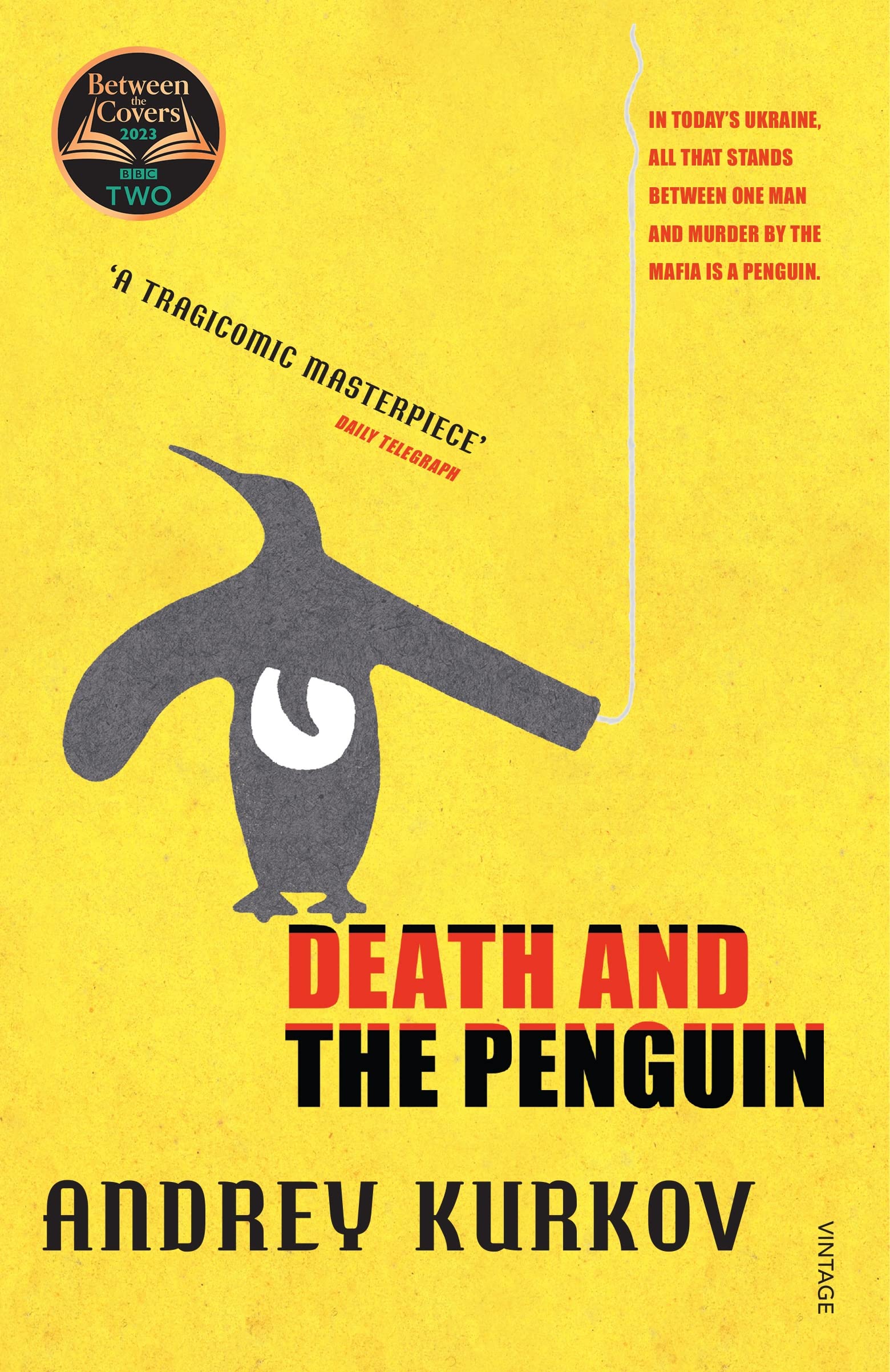
Death & The Penguin by Andrey Kurkov
Death & The Penguin tells the story of a failed writer Viktor Alekseyevich Zolotaryov who lives a lonely life in Kviv, scraping by on selling short, very short, stories. He lives with Misha, a King penguin which he rescued from the local zoo because it could no longer afford to keep all its animals. Viktor is a lonely, melancholic character and Misha is no substitute for human friendship. Misha “brought his own kind of loneliness, with the result of two complementary lonelinesses creating an impression of interdependence rather than amity.
The setting is Ukraine in the late years of the 20th century. Ukraine is throwing off the constraints of membership of USSR and trying to embrace the freedoms of The West but has become a corrupt and lawless society with most of wealth in the hands of a few. The bleak setting of the country is well-captured, with the novel offering a stark portrayal of life in a post-Soviet society.
Kurkov says that he chose a penguin for Victor's companion because they normally live in colonies, so to live in isolation is completely alien to them. In the same way the people of Ukraine after living a collective life organised by the state are suddenly cut adrift and have learn to live more isolated, individual lives.
Misha is a mirror of Viktor. The pengin roams around the flat, occasionally stopping and heaving a sigh, like an old man weary of both life and himself. At a funeral Viktor bends down and talks to Misha: Well Misha, he sighed stooping to the Penguin’s level, that's how we humans bury our dead. Turning at the sound of his master's voice, Misha fixed on him his tiny sad eyes.
Things look up for Viktor when he lands the job of writing obituaries of notable people for a national paper but very quickly we realise that all is not as it seems – Victor has to be anonymous. “In your own interest”, the chief editor says, and extra details for the obituaries are to be provided by the paper’s crime department. Nearly all the obituraies concern people with a nefarious past. When his boss sends him to Kharkov to meet a correspondent the man is murdered, and the dangers of Viktor’s new job become clear.
As the main plotline of the story develops everything becomes more sinister and threatening, but who is behind the threats is a mystery. Viktor is in the dark and so are we. He is told he has to disappear for a short time for his own safety and later even his boss has to flee. Viktor is shocked to be told he is indirectly responsible for the deaths he writes about, but how? When he confronts the editor with this news, he is told he is safe as long as he knows nothing - “The full story is what you get told only if and when your work, and with it your existence, are no longer required.”
We get the impression of two sides at war with each other with Viktor, an unwitting pawn, caught in the middle. But who are the goodies and who are the baddies? All is not fully revealed until the end when Viktor reads his own obituary and knows the truth of his boss’s warning.
The gloomy nature of the story, in which the sun rarely shines, is lightened by other characters.
Sergey the local militiaman becomes a friend and provides Viktor with an escape to a Dacha for New Year. But even here the safety and tranquillity are shattered by an explosion that blows a burglar to pieces and by the unexpected and shocking present of a gun that Viktor receives.
When one criminal character has to flee, he leaves his 4-year-old daughter Sonya in Viktor’s care, and together with Nina who Viktor employs as a nanny, she brings the normality of family life to his home. But poor Viktor struggles to shake off his habitual pessimism and inability to take control.
“Friendship, something he has never had. Any more than a three-piece suit or real passion. Life had been pale, sickly, and joyless. Even Misha was down in the dumps, as if he too, knew only a pallid life devoid of colours, emotions delights and joyous splashings of the soul.
Pidpaly, a penguin expert also provides some light relief yet he tells Viktor: You missed out on the time of abundance, you have, said the old man regretfully. Every century there is five years of abundance after which everything goes to pot. You won't see the next five I'm afraid, I certainly won't, but I did at least come in for one lot.
Viktor knows that somehow he is involved in a criminal operation, but he prefers to shrug his shoulders, gaze out of the window, drink vodka and carry on his normal life.
…he had made no effort to grasp what was taking place around him. Until recently, with the arrival of Sonia. And even now, life around him was still dangerously unfathomable, as if he had missed the actual moment when the nature of events might have been fathomed.
And again:
Although he could not help thinking about it, he found it easier to do so every day, having recognised the complete impossibility of ever changing his life. Harnessed as he was, it was a question of hauling his load until he dropped. So he hauled.
But despite his pretence Viktor is trapped and this aspect of the novel makes for a melancholy read. Even at the end, although Viktor escapes to the Antarctic, we are left wondering what happens to him, to Sonya and Nina and above all to Misha.
The novel is surreal, often bleak but full of black humour. A drunk fisherman sees Victor, Sergey and a penguin.
Eyes fixed on the Penguin, the fisherman shook his head. “Look”, he said at last, “is that a Penguin you've got there or am I seeing things?” “You're seeing things”, Sergey assured him firmly. “Christ”, he whispered aghast.
Viktor asks about one of the victims: How did he die? Like they all do, tragically.
One of the strengths of the novel is its ability to combine humour with darker themes. The relationship between Viktor and Misha is often amusing, and the absurdity of Viktor's job as an obituary writer adds a touch of black comedy to the story. However, the novel is also full of poignant moments that explore the loneliness and despair that Viktor feels as he tries to navigate his difficult and dangerous life.
Death and The Penguin is a blend of humour, suspense, and social commentary. Kurkov's writing style is sharp and witty, with a dark undertone that keeps the reader on edge throughout the novel. The portrayal of Kiev's post-Soviet society is bleak and realistic, highlighting the corruption, poverty, and crime that were prevalent during this time. It is a satisfying and thought-provoking read.
Some Quotes
The poor and sinless did not exist, or else died unnoticed and with no obituary. The idea seemed persuasive. Those who merited obituaries had usually achieved things, thought for their ideals, and when locked in battle, it wasn't easy to remain entirely honest and upright. Today's battles were all for material gain, anyway. The crazy idea list was extinct survived by the crazy pragmatist…
“Drink up!" urged the Chief. "There's no escaping fate. Drink while the champagne lasts!”
Life seemed easy and carefree, despite painful moments and less frequent scruples over his own part in an ugly business. But what, in an ugly world, was ugly? No more than a tiny part of an unknown evil existing generally, but not personally touching him and his little world. And not be fully aware of his part in that ugly something was clearly a guarantee of the indestructibility of his world, and of its tranquillity.
Something was wrong with his life, he thought, walking with downcast eyes. Or life itself had changed, and was as
Life was a road, and if departed from at a tangent, the longer for it. And a long road was a long life - a case where to travel was better than to arrive, the point of arrival being, after all, always the same: death.
He looked into that future and saw so clearly as if for the first time in his life, everything that obstructed the peaceful path for him. It was, oddly enough all connected indirectly with his beloved Misha. Misha had drawn him into a mournful circle of people with an enhanced degree of mortality and now Misha alone could free him from them.
Ukraine Context
During the recession, between 1991 and 1999, Ukraine lost 60% of its GDP and suffered from hyperinflation that peaked at 10,000% in 1993.The situation only stabilized well after the new currency, the hryvnia, fell sharply in late 1998 partially as a fallout from the Russian debt default earlier that year. The legacy of the economic policies of the nineties was the mass privatization of state property that created a class of extremely powerful and rich individuals known as the oligarchs.
From the political perspective, one of the defining features of the politics of Ukraine is that for most of the time, it has been divided along two issues: the relation between Ukraine, the West and Russia, and the classical left-right divide.[155] The first two presidents, Kravchuk and Leonid Kuchma, tended to balance the competing visions of Ukraine,[156] though Yushchenko and Yanukovych were generally pro-Western and pro-Russian, respectively. There were two major protests against Yanukovych: the Orange Revolution in 2004, when tens of thousands of people went in protest of election rigging in his favour (Yushchenko was eventually elected president), and another one in the winter of 2013/2014, when more gathered on the Euromaidan to oppose Yanukovych's refusal to sign the European Union–Ukraine Association Agreement. By the end of the 2014 protests, he fled from Ukraine and was removed by the parliament in what is termed the Revolution of Dignity, but Russia refused to recognize the interim pro-Western government, calling it a junta and denouncing the events as a coup d'état sponsored by the United States.[157][158][159]
Wikipedia entry for Andrey Kurkov:
Kurkov has written 19 Novels: His books are full of black humour, post-Soviet reality and elements of surrealism.
https://en.wikipedia.org/wiki/Andrey_Kurkov
Monday, 8 May 2023
Eugénie Grandet by Honoré de Balzac
Who will marry Eugénie Grandet?
This short classic novel, set in the town of Saumur in
post-revolution France, tells the story of a miser, Felix Grandet and the
coming of age of his daughter Eugénie. She will inherit the miser’s millions
and make her future husband a wealthy man. Two young men are thrust forward by their
families to compete for her favour, but the sudden arrival of her exotic cousin
Charles from Paris, upsets their plans and brings Eugénie into conflict with her
father.
Balzac sets the tone of the novel from the first sentence: “In
certain provincial towns there are houses whose appearance arouses a melancholy
as great as that of the gloomiest cloisters, the most desolate moorland or the
saddest ruins”. The house of M. Grandet is “pale, grey, cold and silent”
and Grandet is “like a serpent, impassive, cold and methodical”. This oppressive atmosphere speaks of the insidious effect of avarice on the life of Felix Grandet. How his life, and the lives of those around him are blighted by greed, is a
main theme of the novel.
Ten years after Balzac’s Felix Grandet, Dickens would create
the character of Ebenezer Scrooge - a squeezing, wrenching, grasping, scraping,
clutching, covetous old sinner! But
unlike Dickens who uses supernatural visitations to bring Scrooge to a place of
remorse and repentance, Balzac is no romantic:
Misers do not believe in an afterlife. The present is
everything for them. This thought casts a terrible light on the present day,
when, more than ever before, money dominates the law, politics and social
behaviour. Institutions books men and doctrines all conspire to undermine the
belief in a life to come which has been the foundation of the social fabric for
eighteen hundred years.
Melancholy and gloom pervade the Grandet household, where the miser rations out the food for the day in the morning and allows only one candle to illuminate the darkness at night. Eugénie and her mother live lives of subservience and scarcely leave the house except to go to church. They are gentle souls who submit to the tyranny under which they live. Yet as the novel progresses Balzac challenges this mercenary outlook in the character of Eugenie. When her cousin arrives from Paris she knows for the first time what it is to fall in love and the experience is overwhelming, Her generous nature, long suppressed, is aroused and, she is completely at odds with her father, She calculates how much money her father has made from selling his wine and says:
"Then Father, you can easily help Charles.
The astonishment, the fury, the stupefaction of Balthazar when he saw Mene, Mene, Tekel, Upharsin written on the wall, were as nothing compared to Grandet's cold rage when, having forgotten about his nephew, he found the young man lodged in his daughter's heart and calculations.
The novel is a masterful exploration of the themes of love,
money, greed, and the corrupting influence of wealth. Balzac presents a vivid
and detailed portrait of the world of 19th-century France, with its rigid
social hierarchy, its obsession with wealth and status, and its hidden depths
of cruelty and deceit.
His prose is rich, lyrical, and highly evocative, capturing
the atmosphere of 19th-century France in all its glory and squalor. Eugénie
Grandet is a timeless masterpiece of French literature, a work of profound
insight and understanding that speaks to the complexities of the human
condition. It is a novel that has stood the test of time and continues to
captivate and enchant readers today.
Friday, 21 April 2023
Super Infinite - The Transformations of John Donne by Katherine Rundell
“The power of John Donne’s words nearly killed a man”. Katherine Rundell’s Super Infinite starts with a bang. Will this biography be a bit dry, a bit academic? Not a bit of it. She says: This is both a biography of Donne and an act of evangelism. She is passionate about Donne and looking for converts. Her enthusiasm, illustrated with multiple quotes of his poetry and prose, and her own use of telling imagery, enliven every chapter.
Donne was born into a Catholic family 1572 in the reign of Elizabeth I, lived through the reign of James I and died in 1631 as Dean of St Pauls, with Charles I on the throne. This was a time when scholars, priests and courtiers, anyone in the public eye, had to tread a careful path of conformity to church and state or risk imprisonment or worse. Donne had his share of troubles and was imprisoned when he married a teenager, Anne Moore, without her father's permission. Katherine Rundell documents the many ups and downs of Donne's life, but it is his poetry, writings and sermons that are her passion.
She claims that Donne is the greatest writer of desire in
the English language, that he belongs alongside Shakespeare at the peak of
English literature, and, she says, to let him fall out of common consciousness would be
as foolish as discarding a kidney or a lung.
She is fascinated by Donne’s complexity. He was incapable of
being just one thing. She writes “he was poet, lover, essayist, lawyer,
pirate, recusant, preacher, satirist, politician, courtier, chaplain to the
King (Charles I) and dean of the finest cathedral in London.
At no point in his life did Donne come to an end of himself.
She delights in Donne’s originality which broke with
convention and did not sit well with his contemporaries. She has plenty of
originality of her own. Here are more quotes:
He wanted to wear his wit like a knife in his shoe; he wanted
it to flash out at unexpected moments.
To read the full text of a Donne sermon is a little like mounting a horse only to discover that it is an elephant, large and unfamiliar.
The pleasure of reading a Donne poem is akin to that of
cracking a locked safe, and he meant it to be so. He demanded hugely of us, and
the demands of his poetry are a mirror to that demanding. The poetry stands to
ask: why should everything be easy, rhythmical, pleasant?
To read his verse is to hear him insist, across the gap
of hundreds of years: for God’s sake, will you listen.
To write about death in the way he did – to send a
suction pump down into the gap between what we know and what we fear – was to risk
chaos. Donne knew it and did it anyway.
There’s a kind of imaginative ferocity to Donne’s writing
about death and it grows overtime as he loses more and more of the people he
loves and their ghosts pile up around him….. He becomes a peddler of the
grotesque, a forensic scholar of the entropy of the body….The body is in its
essentials a very, very slow one man horror show: a slowly decaying piece of
meatish fallibility in clothes over the sensations of which we have very little
control. Donne looked at it, saw it and did not blink. He walked straight at it,
no explanation, justification, no cheerful sallies. There was just a clear-eyed
acknowledgement of the precise anatomy and scale, the look and feel, the
reality of ruin. It was his superpower that unflinching quality. It allowed him
clarity and vision.
….he was the kind of man who demanded of pain that it
shunt you closer to Infinity.
He was a man constantly transforming. He was a one-man
procession: John Donne, the persecuted, the rake, the lawyer, the bereaved, the
lover, the jailbird, the desperate, the striver, the pious, John Donne the
almost dead and reporting from the frontline of the grave.
He’s one whose work, if allowed under your skin, can
offer joy so violent it kicks the metal out of your knees and sorrow large
enough to eat you.
Katherine Rundell spent 10 years researching and writing this life of John Donne. She calls herself an evangelist; she has another convert. I'm going to read John Donne, crack open the safe and open my mind to infinity.
Friday, 14 April 2023
A Tale of Two Cities by Charles Dickens
The opening lines of A Tale of Two Cities are so well known they
are currently being parodied in a radio advert.
It was the best of times, it was the worst of times, it
was the age of wisdom, it was the age of foolishness, it was the epoch of
belief, it was the epoch of incredulity, it was the season of Light, it was the
season of Darkness, it was the spring of hope, it was the winter of despair….
Screen versions of Dickens have made Scrooge, the miserable
miser and Oliver Twist, the hungry orphan, equally well known. The latest
adaptation of Great Expectations has reincarnated Pip, Magwitch & Estelle
for modern viewers. Dickens is grist to the film makers mill, with his
compelling characters and rags to riches stories, but he deserves far more than
easy viewing for tired millennials; he deserves to be read and read again, and
what better place to dive into Dickens than A Tale of Two Cities.
Set against the backdrop of the French Revolution, this epic novel centres on the lives of Doctor Manette, his daughter Lucie, and the two very different men who love her - Charles Darnay a French aristocrat and Sydney Carton a dissolute lawyer. Dr Manette has been released from The Bastille and is being cared for by M. Ddefarge, the owner of a wine shop. Lucie travels to Paris to bring him back to London where he regains his health. Lucie marries Charles Darnay who is lured back to Paris as the Revolution rages through the streets. Lucie, her father and her child follow him.
As the cauldron of revolution reaches boiling point, the wine shop of M. Defarge takes centre stage. Behind the counter Mme. Defarge knits and knits: “What do you make, madame?” “Many things.” “For instance—”. “For instance,” returned Madame Defarge, composedly, “shrouds.”
The anger of the poor erupts in the storming of the Bastille and the Reign of Terror begins. As the armed mob surges through the streets, knives are sharpened on the grindstone, prisons are filled, courts condemn the innocent, and the lives of the Manette family hang by a thread. The novel builds to its climax and Dickens’ descriptive powers are in full flow.
Every day, through the stony streets, the tumbrils now
jolted heavily, filled with Condemned. Lovely girls; bright women, brown-haired,
black-haired, and grey; youths; stalwart men and old; gentle born and peasant
born; all red wine for La Guillotine, all daily brought into light from the
dark cellars of the loathsome prisons and carried to her through the streets to
slake her devouring thirst. Liberty, equality, fraternity, or death; — the
last, much the easiest to bestow, O Guillotine!
Dickens is a supreme storyteller, and the action moves along
at a rapid pace, much like modern TV soaps, with characters, plotlines, and
mysteries all combining to draw the reader on. Why was Dr. Manette imprisoned?
What is Charles Darnay’s aristocratic past? Why does Defarge demand to see Dr.
Manette’s cell in the Bastille?
Aside from these mysteries, Dickens raises larger questions.
How far should retribution go? Does the tyranny of death by starvation justify
the tyranny of death by guillotine? Should a man pay for the crimes committed
by his cruel, aristocratic family, a family which he has renounced and
rejected? At the end of the book, a man and woman face their final moments
before the guillotine, and Dickens confronts the reader with the ultimate
question - Is death the end of all hope?
The last line of this great novel is as memorable as the
first.
“It is a far, far better thing that I do, than I have
ever done; it is a far, far better rest that I go to than I have ever known.”
A Tale of Two Cities is a magnificent read. It tops the list
of bestselling novels with over 200 million sales. Time to get your copy and
dive into Dickens.
Thursday, 9 February 2023
Act Of Oblivion by Robert Harris
On the 29th of January 1649, a document was signed by 59 men. Against each signature was a personal seal, stamped in red wax. The third signature read, “O Cromwell”. The document was the death warrant of King Charles I, beheaded in Whitehall the following day. When the axe fell a loud groan rose from the crowd, but perhaps not from 15-year-old Samuel Pepys who was present and later told his school friends, if he had to preach a sermon on the king, his text would be “The memory of the wicked shall rot”. The triumph of Cromwell and the Puritan faction lasted just 11 years. Following Cromwell’s death in 1658, The Commonwealth was finished. Two years later Charles II landed at Dover, and the monarchy was restored. Now it was time for revenge. Parliament passed the Act of Indemnity and Oblivion and the pursuit of the regicides who had signed the death warrant, and who were not already dead or in The Tower was set in motion.
In Act of Oblivion, Robert Harris recreates the story of this pursuit and in particular, the hunt for Edward Whalley and his son-in law William Goffe, who escaped across the Atlantic to the Puritan settlements in New England. In his introduction Harris states, “The events, dates and locations are accurate and almost every character is real”. However, he does invent the character of Richard Nayler, the chief man-hunter who is given a compelling motive for pursuing the regicides to the ends of the earth. Nayler is arrested on Christmas Day by two Colonels from Cromwell’s army. His crime? - celebrating the Feast of the Nativity and using the Book of Common Prayer when such celebrations are forbidden. On the evening of his arrest his pregnant wife Sarah, goes into premature labour and dies giving birth to a stillborn son. Nayler’s mind is now implacably set on hunting down the two colonels who arrested him, none other than Edward Walley and William Goffe now safe in America, so they think.
We first meet Nayler when he is ordered by the Privy Council to accompany Isabelle Hacker to her home, Stathern Hall in Leicestershire, to fetch the warrant with its list of 59 names, that authorised the execution of the King, Her husband, Colonel Hacker is named on the warrant, one of the three officers ordered to carry out the execution and who is now under arrest. Nayler reads the warrant; “Whereas Charles Stuart King of England is and stands convicted and condemned of High Treason …….. to be put to death by the severing of his head from his body”, and so the reader is introduced to one of the most famous documents in English history.
Robert Harris skilfully merges fact and fiction in this excellent novel – “a chewy, morally murky slice of history” (The Times). The reader begins to understand the Puritan mindset, the devotion to the bible and prayer; the over-arching authority of preachers and the church; the belief that they are the saints, the chosen ones, and that all the events of their lives and the wider world are in the hands of God – every victory a blessing and every defeat a punishment. He also uses the device of Edward Walley writing his memoirs to inform the reader of the main events of the Civil War. Occasionally the action switches to Europe, with stories of betrayal and murder as the long arm of Parliament seeks revenge on those regicides who had escaped across the channel.
One of my daughters asked me how she could get into history, so I suggested reading historical novels and pointed her in the direction of “An Officer and a Spy” a re-telling of the Dreyfus Affair in 1890’s France, also by Robert Harris. She read it and enjoyed it, and now knows something of the pernicious influence of antisemitism. So, if you want to get lost in a book that reads like a thriller – Hunt, Chase, Hide & Kill are the 4 sections – and at the same time learn more about the struggle between King & Parliament, the New England colonies, and the hunger for religious certainty, you can do no better than read Act of Oblivion.
Saturday, 14 January 2023
Our Souls at Night by Kent Haruf
Kent Haruf was a teacher and this, his last book is built to some extent on his own story.
In the first chapter an elderly widow, Addie Moore calls on her neighbour, Louis Waters, an elderly widower, with a very unusual request. “I wonder if you would consider coming to my house sometimes to sleep with me.” She makes it clear that this is about her loneliness which is worst at night. Perhaps two lonely old people can find companionship – not sex – together. Louis is reluctant but agrees.
As we read we begin to get the back stories of their lives. Neither had perfect marriages. Addie’s was marred by the tragic death of her 11 year old daughter and Louis’s by his brief affair with a fellow teacher. When Addie’s grandson Jamie, comes to live with her while her son Gene tries to repair his rocky relationship with his wife, Louis & Addie find themselves acting like surrogate parents. This adds a different and youthful dynamic to their new relationship. However, at the end of this brief story, that seems to offer so much hope and fulfilment for two lives in decline, Kent Haruf presents Addie with a painful choice between family and friendship. The reader is left wondering if she made the right decision.
This novella is a sensitive exploration of family life; the damage parents can do to children, the loneliness of old age and the problems of second relationships. All set in a small town where no one’s business is private and where conforming to the social norm is expected. But Addie no longer cares what the neighbours think as she seeks to break free from the constraints of family and society in her new relationship with Louis.
“I made up my mind I’m not going to pay attention to what people think. I’ve done that too long—all my life. I’m not going to live that way anymore.”
Instead of looking ahead to years of slow decline she wants to slow down the end-of-life clock and create something new. The various themes of the story are explored with warmth and humanity in a minimalist style, short sentences and short chapters in a short book.
The novel is praised by the likes of Peter Carey – “If you have never entered his beautiful singing sentences, I envy you your first time”, and the New York Times – “So delicate and lovely that it has the power to exalt the reader”, but some members of the book group found it disappointing:
Sad & melancholy. Not uplifting with a disappointing ending
Very bitty and unsatisfying. Some key relationships and characters needed to be explored in greater depth. But I liked this quote:
“Who does ever get what they want? It doesn’t seem to happen to many of us if any at all. It’s always two people bumping against each other blindly, acting out old ideas and dreams and mistaken understandings.”
On balance, I hated it!
On the other hand:
Very insightful book
I like the lack of speech marks and the comforting details. It’s an unusual book. Addie and Louis looked back on their lives with sadness and regret but as Louis said, “You can't fix things, can you, Louis said. We always want to. But we can't.”
I enjoyed the beginning and the American scene which I knew from touring that part of the USA. Did not enjoy the ending.
A strong evocation of happiness in old age.